Powder coating booths, Powder coating spray booths
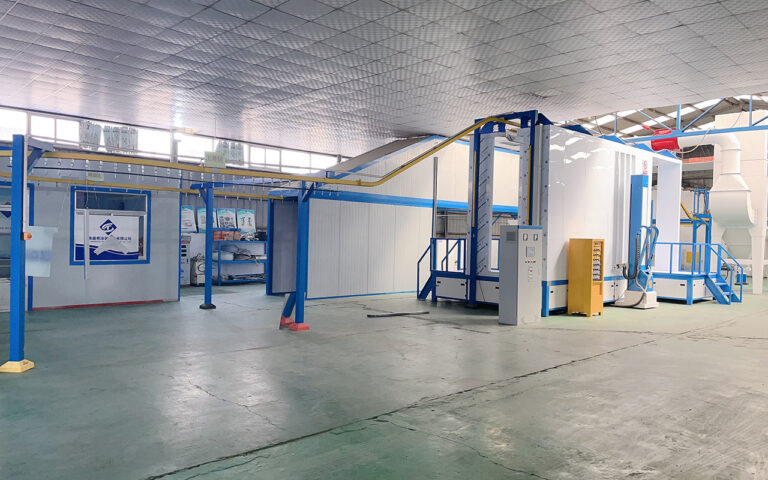
The powder coating spray booths is the core equipment of the electrostatic powder coating system. Its aerodynamic design maintains a stable airflow, keeping dust content below the lower explosive limit of 10g/m³, ensuring operational safety. Constructed of stainless steel, it is equipped with a vibrating screen filter and a quick color-changing device, supporting multi-color powder interchangeability. An integrated 500LX illumination system ensures visibility during coating operations and forms an interlocking production line with the powder supply center and recovery unit, realizing a complete process flow from loading to degreasing, powder coating, and curing.
The equipment features a dual-stage recovery system combining cyclone separation and filter technology, achieving a 99% powder recovery rate while shortening color-changing time. The semi-enclosed structure design using PP/PVC materials and a dense-phase conveying method effectively prevents powder spillage and environmental pollution. Its intelligent upgrades include a touchscreen operating system, pulse backflushing self-cleaning function, and a powder balance monitoring module, driving increased production efficiency.
Technical Characteristics:
Employing a vertical laminar flow airflow design, the exhaust system maintains a stable flow rate of 0.3-0.6m/s per minute, effectively intercepting 98% of suspended powder particles. The system features two internal filtration barriers: a primary metal screen filters large particles, while a secondary fiber filter captures fine dust, ensuring that the circulating powder particle size is ≤80μm.
A digital control system monitors dust concentration in real time, automatically initiating emergency extraction when the detected value exceeds 25% of the lower explosive limit (i.e., 10g/m³). A V-shaped powder deposition tank at the bottom, combined with a PTFE-coated inner wall, increases the residual powder removal rate to 99%.
Structural Composition:
The main frame is welded from 304 stainless steel, with 2.5mm thick walls and a compressive strength ≥150kPa. It includes three main functional modules:
- Spraying Area: A honeycomb pressure equalization plate at the top ensures uniform airflow distribution.
- Powder Recovery Area: Equipped with a dual recovery device of a cyclone separator and a bag filter.
- Electrical Control Area: Integrates a PLC control system and a fault diagnosis unit.
- The observation window uses explosion-proof glass, creating a shadowless lighting environment with explosion-proof lighting fixtures.
- Four sets of omnidirectional casters are installed at the bottom, with a load-bearing capacity of 800kg/m².
Supporting Systems:
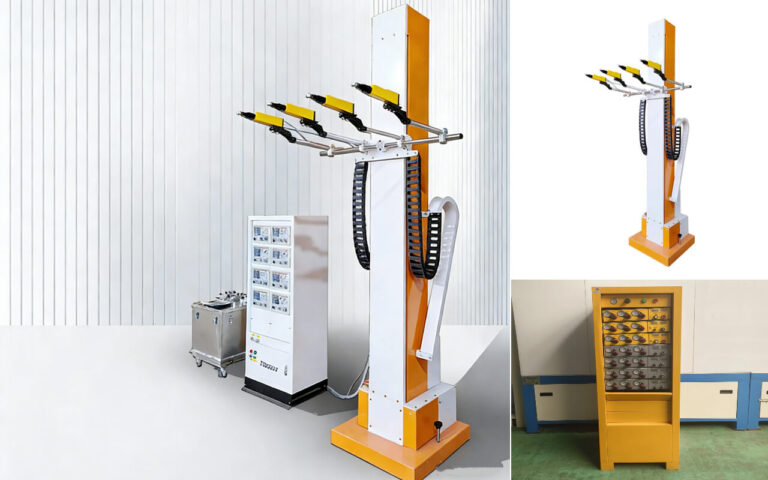
The powder supply center is equipped with a 32-channel powder distributor, supporting simultaneous operation of 24 spray guns with a powder supply accuracy of ±1.5g/min. The fluidized bed adopts a microporous ceramic plate structure, reducing compressed air consumption by 40% and achieving a powder fluidization uniformity of 98%. A pulse backflushing device is included, saving 92% of manual cleaning time per color change.
The recovery system employs a two-stage separation technology: The first-stage cyclone separator utilizes a dual-vortex airflow to achieve 85% coarse powder recovery. The second-stage filter cartridge captures the remaining 15% fine powder, with a filtration accuracy of 0.1μm. Equipped with a differential pressure sensing system, the system automatically triggers a dust removal procedure when the filter resistance exceeds 1200Pa.
Process Integration
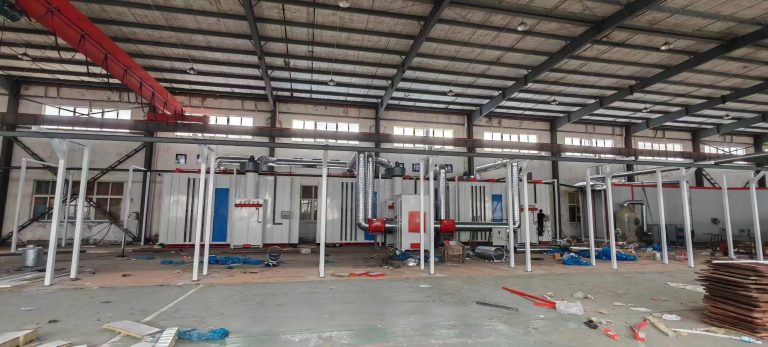
In a typical coating production line, the powder coating chamber is linked with upstream and downstream equipment:
- Pretreatment Unit: Degreasing tank → Washing tank → Phosphating tank.
- Spraying Unit: Automatic spray gun assembly → Manual touch-up spraying station.
- Curing Unit: Infrared preheating section → Hot air circulating oven.
- Cooling Unit: Forced air cooling tunnel.
The equipment is equipped with a Modbus communication interface, which can be connected to the MES system to achieve real-time production data acquisition, generating powder consumption reports and equipment operation logs every 8 hours. By changing the filter element type (nylon/polyester/glass fiber), it can adapt to the recycling needs of different powder materials such as epoxy, polyester, and fluorocarbon.