

 English
 Español
 Português
 Русский
 عربي
عربي Türkçe
 Deutsch
 Polski
 Français
 Italiano
 Tiếng Việt
How Does Passenger Vehicle Painting Work? A Complete Guide to Modern Automotive Coating Technology

Introduction: Why Automotive Painting Matters
Passenger vehicle painting is one of the four core processes in modern automotive manufacturing—alongside stamping, welding, and final assembly. Far beyond aesthetics, it plays a critical role in long-term vehicle protection. Today's automotive coating systems combine advanced materials science, automation, and precision engineering to deliver both durability and visual appeal.
This guide provides a comprehensive overview of passenger vehicle painting, from core objectives to cutting-edge industry trends.
Core Objectives: Protection Meets Aesthetics
Automotive painting serves two primary purposes:
1. Superior Protection
A high-quality coating system must provide:
Corrosion resistance (e.g., ≥700 hours in salt spray testing)
Weather durability (no blistering or chalking after 2 years of exposure or 4 years of use)
Mechanical strength to withstand wear and impact
2. Premium Appearance
Modern consumers expect flawless finishes, requiring:
High gloss levels (typically ≥90)
Uniform color consistency (no visible color difference)
Defect-free surfaces (no orange peel, runs, or particles)
The Standard Process: Multi-Layer Coating System
Automotive coatings follow a structured, multi-layer process often referred to as "4-coat 3-bake" or "4-coat 2-bake." Each layer serves a distinct function:Pre-treatment
The process begins with degreasing, phosphating, or silane treatment to remove contaminants and form a chemical conversion layer. This enhances adhesion and corrosion resistance.
Cathodic Electrodeposition (E-coating)
The vehicle body is immersed in a coating bath where paint is deposited uniformly using electrochemical principles. This ensures full coverage—even in hidden cavities—providing the foundation for corrosion protection.
PVC Sealing and Underbody Coating
Seam sealing prevents water and air leakage
Underbody coating protects against stone chips and road debris
Primer (Intermediate Coat)
Applied between the e-coat and topcoat, the primer:
Smooths surface imperfections
Enhances paint fullness
Improves adhesion
Provides UV shielding
Topcoat Application
The final visual layer typically includes:
Basecoat: Provides color and effects (solid, metallic, or pearlescent)
Clearcoat: Adds gloss, hardness, scratch resistance, and weather protection
Key Materials: Innovation from Base to Finish
E-coat Technology
Cathodic electrodeposition coatings dominate the industry, evolving into lead-free, tin-free, and eco-friendly formulations with improved penetration and reduced energy consumption. Advanced systems now even enable primer elimination through dual-layer e-coat processes.
Eco-Friendly Paint Solutions
Driven by environmental regulations, the industry is shifting toward:
Waterborne coatings: Reduce VOC emissions by over 80% and are now mainstream
High-solid coatings: Lower solvent content while maintaining performance
Powder coatings: Solvent-free and highly efficient, often used for primers or clearcoats
Coatings for Plastic Parts
Plastic components like bumpers require:
Low-temperature curing coatings (60–80°C) to prevent deformation
Strict color matching standards (ΔE ≤ 0.6)
Emerging water-based low-temperature integrated coating technologies allow metal and plastic parts to be painted together at 80°C, significantly reducing energy use and investment costs.
Modern Production: Smart, Green, and Efficient
High Automation
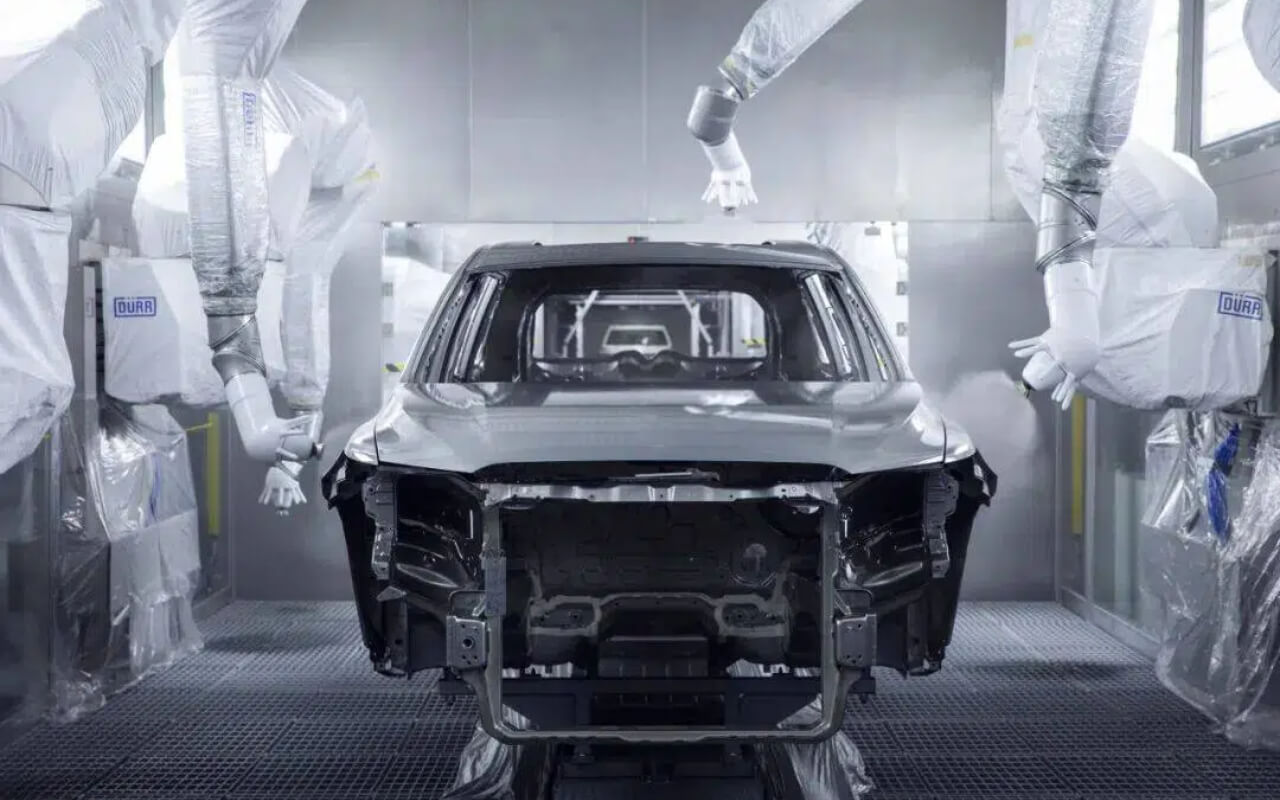
Robotic spray systems dominate production lines. Equipped with 3D vision systems, they:
Identify vehicle geometry
Optimize spray paths
Achieve paint utilization rates above 80% using electrostatic rotary atomizers
Intelligent Process Control
Centralized control systems integrate:
Machine vision + AI algorithms for 100% inline inspection
Detection of thickness, color deviation, and surface defects (≥98% accuracy)
Real-time parameter adjustment for closed-loop control
Digital twin technology further enables simulation and optimization of the entire process.
Environmental Sustainability
Green manufacturing is a core priority:
Waterborne coatings reduce VOC emissions
Regenerative Thermal Oxidizers (RTO) achieve:
99% VOC removal
90% heat recovery
Wastewater is treated and recycled to minimize environmental impact
Future Trends in Automotive Painting
Process Simplification
Technologies like dual-layer e-coating aim to eliminate primer steps, reducing costs and complexity while maintaining performance.
Extreme Customization
From standard finishes to ultra-high-gloss mirror effects, painting defines brand identity. Luxury manufacturers achieve exceptional finishes through:
Additional wet sanding
Extended polishing processes (e.g., up to 16 hours for showroom-quality mirror finishes)
Full Digitalization
End-to-end digital platforms enable:
Flexible, customized production
Full traceability from order to delivery
Seamless integration of manufacturing data
Conclusion: A High-Tech System Behind Every Finish
Passenger vehicle painting has evolved from basic protection to a sophisticated, high-tech system integrating materials science, chemistry, automation, optics, and digital control. Today, it stands as a cornerstone of modern automotive manufacturing—delivering not just durability, but sustainability, intelligence, and aesthetic excellence.


