

 English
 Español
 Português
 Русский
 عربي
عربي Türkçe
 Deutsch
 Polski
 Français
 Italiano
 Tiếng Việt
Deep Dive into Power & Free Conveyor System Design

Abstract: The Power & Free (P&F) conveyor system is a fully functional and flexible material handling equipment. It not only conveys workpieces but can also sort and store different workpieces, making it widely applicable in industrial production. This article introduces the engineering design of a P&F conveyor system, taking an example from the welding workshop of an automobile factory.
Keywords: Power & Free System, Engineering Design, Production Automation
I. Process Overview
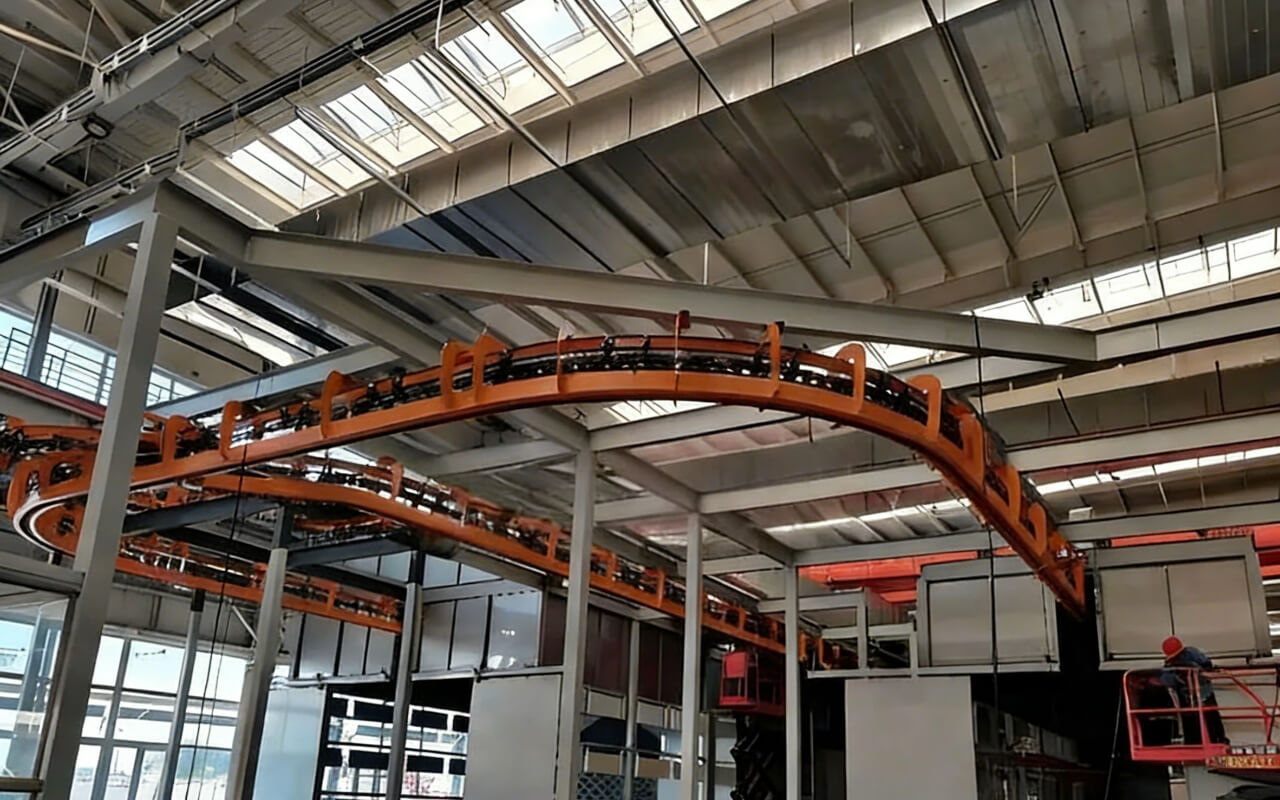
1. Production Program:
The capacity of Line A is 90,000 vehicles per two shifts. The capacity of Line B is 50,000 vehicles per two shifts. The total P&F system capacity meets 140,000 vehicles per two shifts. The maximum weight of a body-in-white (BIW) is 500kg.
2. Process Flow:
- Loading Station: Qualified BIWs, having completed welding in the welding workshop, are transferred onto the P&F conveyor carrier.
- Storage Zone (Accumulation Area): Different types of BIWs can be stored in classified zones.
- Conveyor Line: Conveys the BIWs stored on the P&F carriers to the painting workshop.
Unloading Station: The BIWs are transferred from the P&F carrier onto the skid conveyor of the painting workshop.
3. Plant Structure:
The plant is a light steel structure with uniform process loads distributed throughout the workshop. The structural grid is 1 point per 8m along the length of the workshop and 1 point per 3m along the width (perpendicular to the workshop). This results in a 3m x 8m grid distribution, with each lifting point supporting a vertical load of 4.5t and a horizontal load of 0.8t.
II. Determination of the P&F System Route and Main Equipment
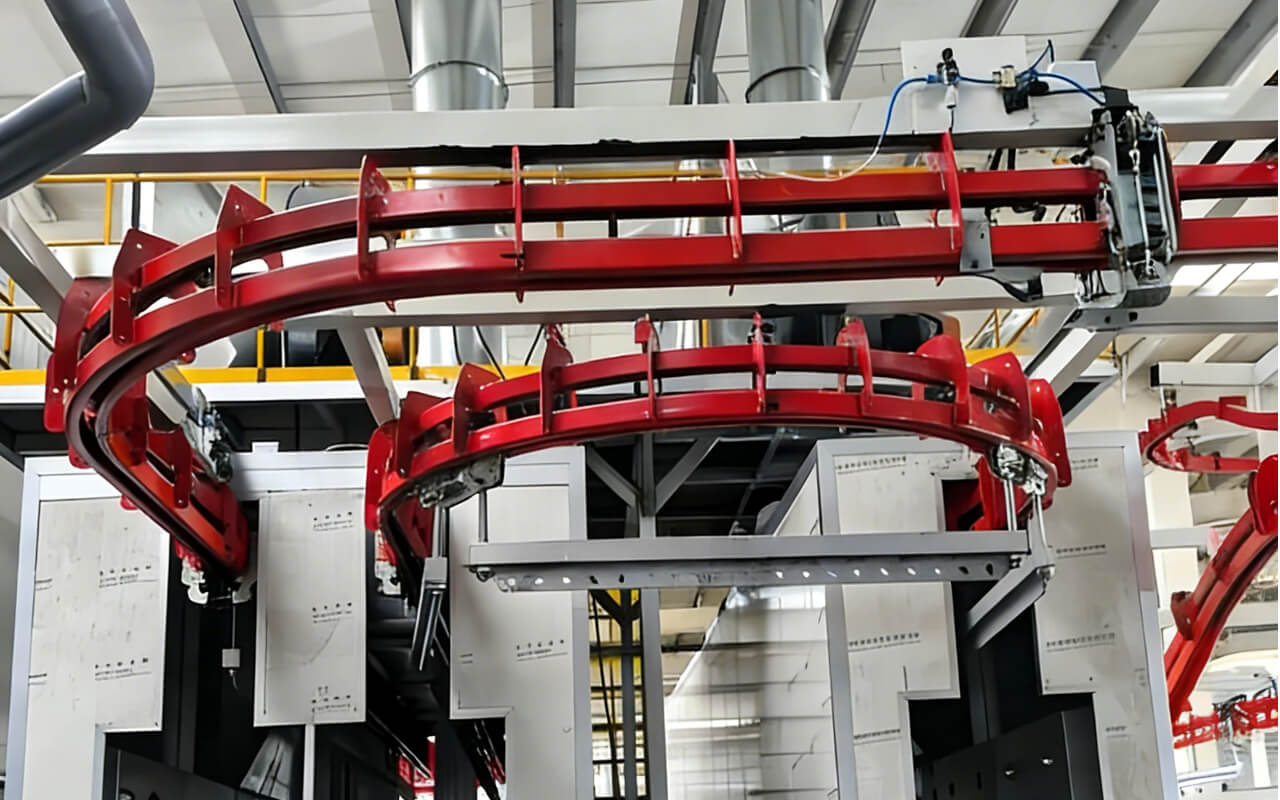
System Components: Loading hoist/elevator, Conveyor line, Storage zone, Unloading hoist/elevator, Electrical control system.
1. Loading Hoist/Elevator (Lifter):
One lifter is installed at the loading position of both Line A and Line B. The lifter segment, which includes a lifter roller conveyor, rises to the required height and transfers the BIW into position. The stopper on the P&F line in front of the waiting position opens, and the empty carrier is pulled by the chain to the lifter stopper. The carrier is then positioned and located by the carrier pin positioning device. The lifter descends, separating the lifter roller conveyor from the workpiece, which settles onto the empty carrier. The lifter continues to descend to the receiving position. The lifter segment stopper opens, and the loaded carrier is pulled by the chain into the storage line.
2. Conveyor Line:
The route is designed in the most scientifically rational way, ensuring the conveying system does not interfere with other equipment in the workshop. The route meets the requirements for BIW conveying and storage. The total route length is about 2000 meters, with 6 drive stations set up to control six separate conveyor chains.
3. Storage Zone:
Since the workshop produces three major product series and the required sequence of vehicles in the paint shop differs from the welding shop's production sequence, the sequence and storage of the BIWs must be considered. Based on the actual conditions and available space in the workshop, three storage lines are designed to store three different types of BIW, with each line capable of storing 20 BIWs. An additional express channel is also included, allowing BIWs coming online to bypass the storage area and proceed directly to the painting workshop via the conveyor line.
4. Unloading Hoist/Elevator:
The loaded carrier is pulled by the chain to the lifter stopper, where the carrier pin positioning device locates the carrier. The lifter rises to the required height, lifts the BIW, and the BIW separates from the carrier. The carrier pin positioning device disengages, the carrier stopper opens, and the empty carrier is pulled away from the unloading station by the chain. The BIW is then transferred by a telescopic fork onto the paint roller skid.
III. Structural Features and Performance of Main P&F System Equipment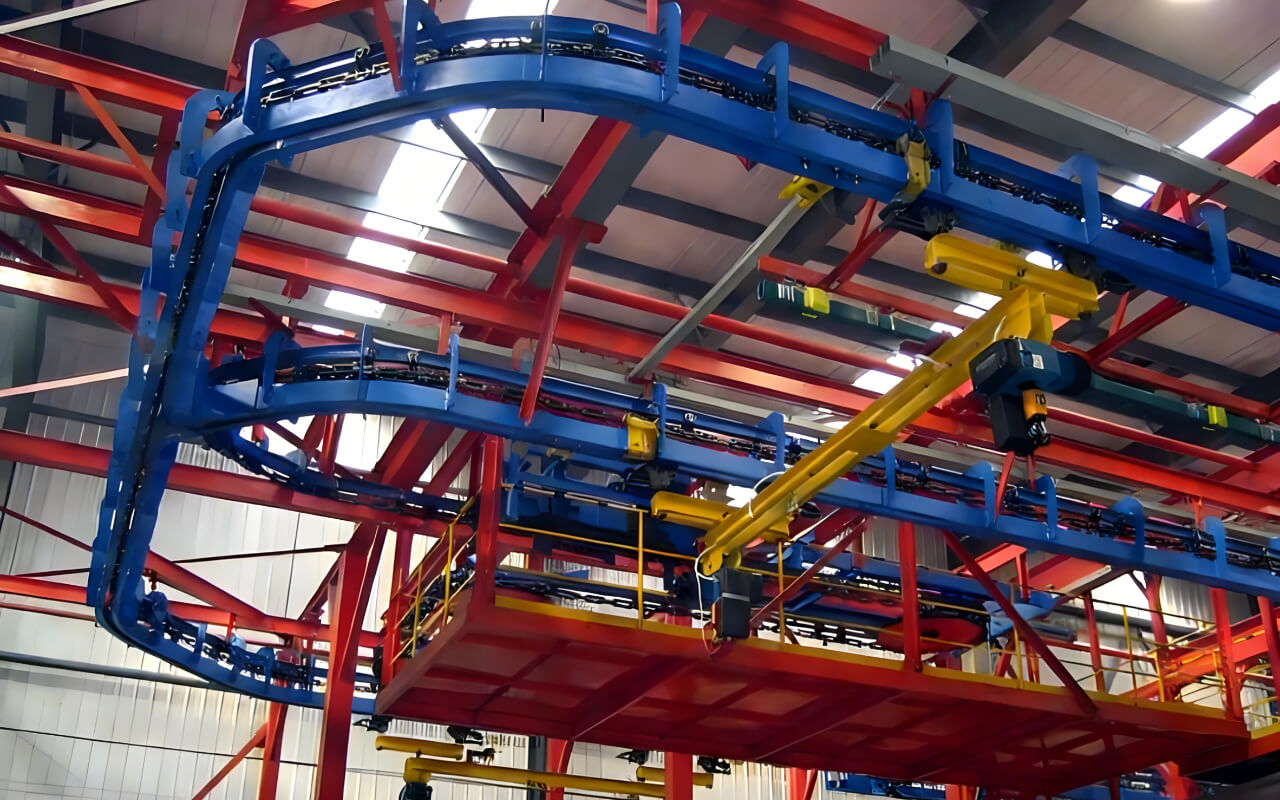
The conveying system uses a 4-inch wide, single-unit, push-head, over-the-track P&F overhead conveyor to transport the products. The main components include the drive unit, tensioning device, chain, trolley/slave trolley, pusher, straight track, horizontal curved track (roller bends), vertical curved track, switches, carrier assembly, stoppers, dispatchers (decoders), safety guard nets, and other installation steel structures. The structural forms are as follows:
1. Drive Unit
The drive unit adopts a linear transmission form. The linear drive station is equipped with an independent caterpillar-type drive chain to drive the traction chain. The guide plate of the caterpillar-type drive chain has a large arc shape to minimize fluctuation of the traction chain and ensure smooth driving. The linear drive station consists of a fixed frame and a floating frame. The drive motor uses variable frequency speed control and is equipped with an overload protection device.
The caterpillar-type linear drive unit comprises a machine frame, a floating frame, a gear motor, and a drive chain. The motor directly drives the reducer via a coupling and features a linear (rotating) floating mechanical overload protection. The robust support frame ensures the drive unit provides sufficient driving force. The adjustable tensioning wheel and chain support mechanism make it simple and convenient to install and adjust the chain meshing clearance. In case of overload, the linear floating mechanical overload protection can signal and cut off the power in a timely manner. An inspection platform is set up at the drive unit for easy access to every component. Grease points are conveniently positioned for manual lubrication.
2. Tensioning Device
The P&F conveyor adopts a pneumatic tensioning mechanism, with roller supports between the fixed and floating frames. Limit switches are installed at both ends of the tensioning device to protect against insufficient chain tension and over-travel of the tensioning device. A pneumatic tensioning device with a stroke of s=800mm is selected, ensuring it can absorb a chain length equal to one pusher pitch. After adjustment, the unused stroke of the tensioning device is not less than 50% of the total stroke. The tensioning device is equipped with an inspection platform.
3. Chain, Trolley (Slave Trolley), and Pusher
The traction chain uses a standard forged detachable chain, made of 45Mn2 steel. The X-458 chain has a breaking load and allowable tension of 216kN and 15kN, respectively, with a theoretical pitch of 102.4mm. The chain must run without crawling or jumping.
The traction chain is supported by chain support trolleys. The trolley body is a high-strength, integral forged part. The support trolley is assembled with bolts. The rollers are integral bearing wheels (full ball complement without cage), offering moderate clearance, low resistance, three-layer labyrinth seal protection, and an external pressure-type lubrication nipple, making them suitable for use in high-temperature and harsh environments. The trolley layout is rational and coordinated with the traction chain's vertical and horizontal turns. Double-group support should be used on both sides of the pusher.
A four-wheel carrier load trolley is used, consisting of one front trolley, one rear trolley, two middle trolleys, one buffered connecting rod, one rigid connecting rod, and one dispatcher rod. The front trolley of the load trolley is the traction trolley. The front trolley cooperates with the stopper and the rear trolley to realize the stopping and accumulation functions. The middle trolleys are used to support the carrier. Two sets of connecting pins can bear the carrier. One set of connecting rods with a buffering function ensures the accumulation length and realizes the buffering of the carrier set. The front and rear trolleys are made of precision cast steel. The trolley body and side plates are connected with high-strength bolts and lock nuts to ensure the safety and reliability of the trolley. The load trolley meets the requirements for simple installation, flexible operation, reasonable structure, sturdiness, durability, and convenient maintenance. It has moderate clearance, low resistance, good sealing, and an external pressure-type lubrication nipple.
4. Track (Straight Track)
The track consists of three sections of profiled steel, connected by welding, with the combination between track sections achieved by bolting. The chain track uses I10 steel, and the trolley track uses 4" special channel steel.
5. Horizontal Curved Track (Roller Bends)
The horizontal turning section of the chain track in the horizontal curved track is equipped with roller bends to ensure the correct trajectory of the traction chain and the correct meshing relationship between the pusher and the trolley. In the horizontal turning section, the traction chain will contact the rollers of the roller bends, which have a certain hardness. The rollers are installed in a specially made wheel groove track. The rollers are equipped with sealed bearings with external oil nipples for regular lubrication. The angle of the horizontal curved track is determined by the overall line layout. The material used for manufacturing the horizontal curved track is the same as the straight track.
6. Vertical Curved Track
The surface of the vertical curved track is smooth, and its curvature does not affect the tension of the chain. The track curvature is determined according to the process requirements.
7. Switches (Turnouts)
Switches are divided into diverting switches and converging switches.
- Diverting Switches: Used to divide one line into two. The direction selection when the load trolley passes through the diverting switch is automatically controlled by the PLC in the electrical control room via a solenoid valve, air cylinder, and switch tongue in the switch's pneumatic unit.
- Converging Switches: These are uncontrolled switches, used to merge two lines into one. The load trolley passes through the converging switch by relying on the trolley itself to push open the switch tongue.
8. Carrier Assembly
The carrier assembly consists of a front trolley, two middle trolleys, a rear trolley, front and rear connecting rods, and the carrier (jig).
9. Stopper
The stopper uses an air cylinder-driven roller stop plate type. When the stopper is engaged, it stops the front trolley pusher of the carrier assembly after it disengages from the traction chain pusher rod, thus positioning it. This system is equipped with an in-position detection device for the stopper.
10. Safety Guard Nets and Other Installation Steel Structures
As an integral part of the system, safety guard nets are installed in areas where the conveyor line passes. The installation steel structure adopts an independent truss hanging scheme.
IV. P&F Chain Electrical Control System Design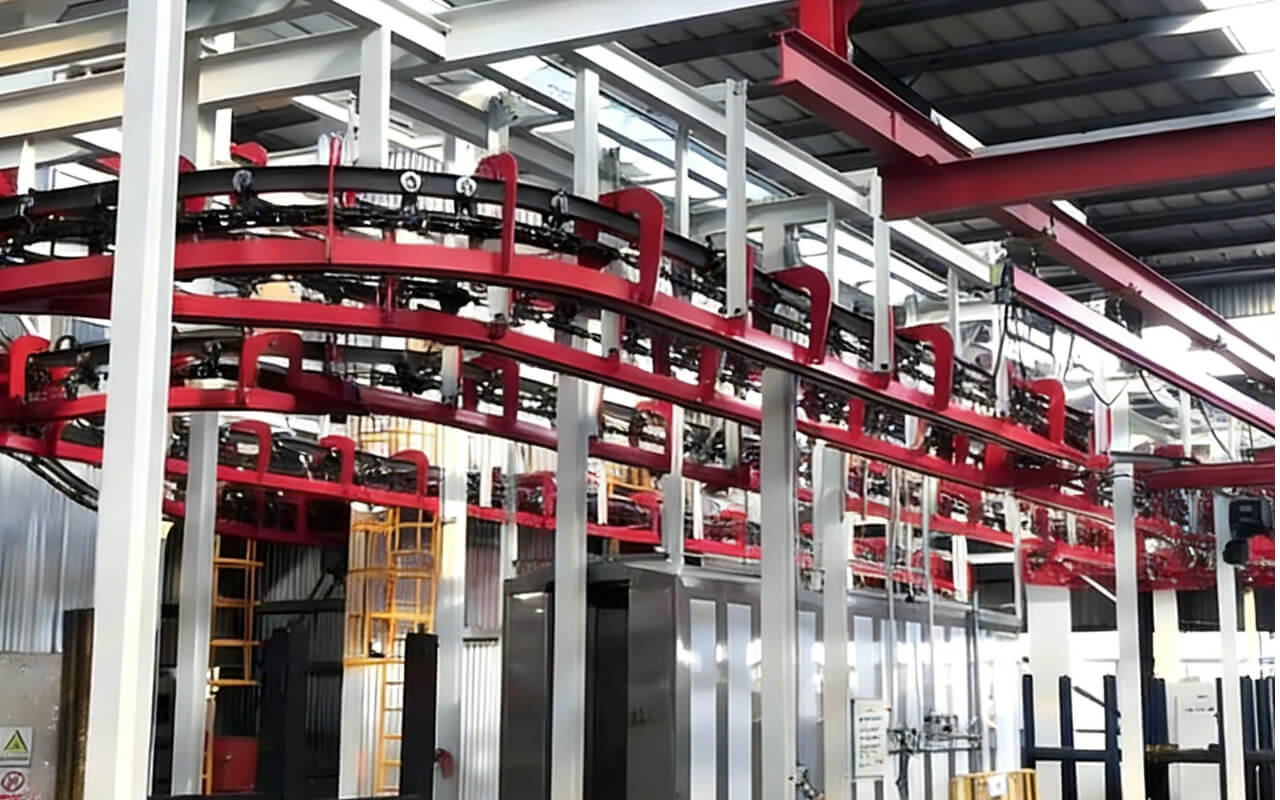
The electrical control system adopts the Siemens S7 series PLC as the core for equipment- level control, configured with Ethernet communication modules and fieldbus communication modules. A music alarm sounds before the automatic start of the line. The main circuit of all system motors is equipped with low-voltage circuit breakers. The control circuit is jointly completed by the PLC and frequency converters to achieve high/low speed and forward/reverse operation of the motors. At the same time, the frequency converter control circuit provides fault output for overload, short circuit, phase loss, and other protection functions for the motors.
The acquisition of field input signals and the exchange of information with the adjustment line and the painting workshop adopt fieldbus technology. This technology has excellent openness and a complete, rigorous network protocol. The PLC master station and the operating stations below it form a Profibus-DP network through the bus, ensuring reliable data reading and writing between the PLC and the sub-stations, and ultimately guaranteeing the automated production and automatic control of process parameters for the entire line through programming. The status of all field equipment can also be sent to the PLC first, and then to the host computer for centralized monitoring via the fieldbus network. The control scheme is simple, the structure is concise, and maintenance is convenient. In addition, the control cabinet is equipped with a touch screen for displaying the equipment's operating status and for quick fault inquiry.
The P&F chain electrical control system consists of one Master Control Panel (MCP), three Remote Control Panels (RCP), and nine Operating Stations (OS). The MCP is the Welding P&F Chain Master Control Panel; the RCPs are the P&F Chain Electrical Control Cabinets RCP01, RCP02, and RCP03; the OSs are Operating Stations BS01, BS02, BS03, BS04, BS05, BS06, BS07, BS08, and BS09. Among these, Operating Stations BS01, BS03, and BS09 are equipped with touch screens.
The P&F chain drive system consists of 6 drive motors: M1, M2, M3, M4, M5, and M6.
P&F Chain Line Start-up Procedure:
Close the main circuit breaker inside the Welding P&F Chain MCP to supply power to RCP01, RCP02, and RCP03 → Close the circuit breakers inside RCP01, RCP02, and RCP03 to supply power to the PLCs, electrical appliances inside RCP01, RCP02, and RCP03, and to the Operating Stations BS01 to BS09 → Close the circuit breakers inside the Operating Stations to supply power to the PLCs and electrical appliances inside the Operating Stations → If everything is normal, the control power can be closed with a key, and the control power indicator light turns on → Go to Remote Station RCP01, select the line running mode: "Semi-Automatic," "Maintenance," or "Automatic" → Close the motor circuit breakers inside the Remote Station to enable the start of M1, M2, M3, M6, M4, and M5 drive motors, driving the chain line → Go to Remote Station RCP01, press "System Start."
If the "Maintenance" mode is selected, the System Start indicator light turns on. If "Semi-Automatic" or "Automatic" mode is selected, the chain line will start running automatically, and the System Start indicator light will turn on.
P&F Chain Line Stop Procedure:
Go to Remote Control Panel RCP01 and press "System Stop." The chain line stops, and the System Stop indicator light turns on.
The chain line operation modes are "Semi-Automatic," "Maintenance," and "Automatic." If the line running mode is "Maintenance," the lifters LF1, LF2, and the stoppers can be operated manually for maintenance personnel debugging. If the line running mode is "Semi-Automatic" or "Automatic," all dispatchers and stoppers can only operate when the chain line is running. If the chain line enters an emergency stop, all dispatchers and stoppers will maintain their current state until the chain line is restarted.
If equipment failure occurs, immediately press the emergency stop button on the Remote Control Panel, Operating Station, or button box. After fault repair is completed, the chain line can only be restarted after pressing the "Fault Reset" button.
Production Indicator Test:
Press the "Test Indicator" button; all lights illuminate accompanied by a buzzer sound. Releasing the button stops the test.
Currently, the overhead conveyors used by automobile manufacturers are not just for conveying workpieces and car bodies; they are a complete mechanical and electrical control system with a very high degree of automation. They can support the co-line production of multiple car body types and can realize the conveying and storage of car bodies according to production requirements. The transfer station requires accurate positioning and automatic transfer. The entire P&F conveyor system can accurately deliver the BIWs completed in the welding workshop to the painting workshop without requiring manual worker operation.


