

 English
 Español
 Português
 Русский
 عربي
عربي Türkçe
 Deutsch
 Polski
 Français
 Italiano
 Tiếng Việt
Automotive Painting with High-Voltage Electrostatic Rotary-Cup Spray Robots
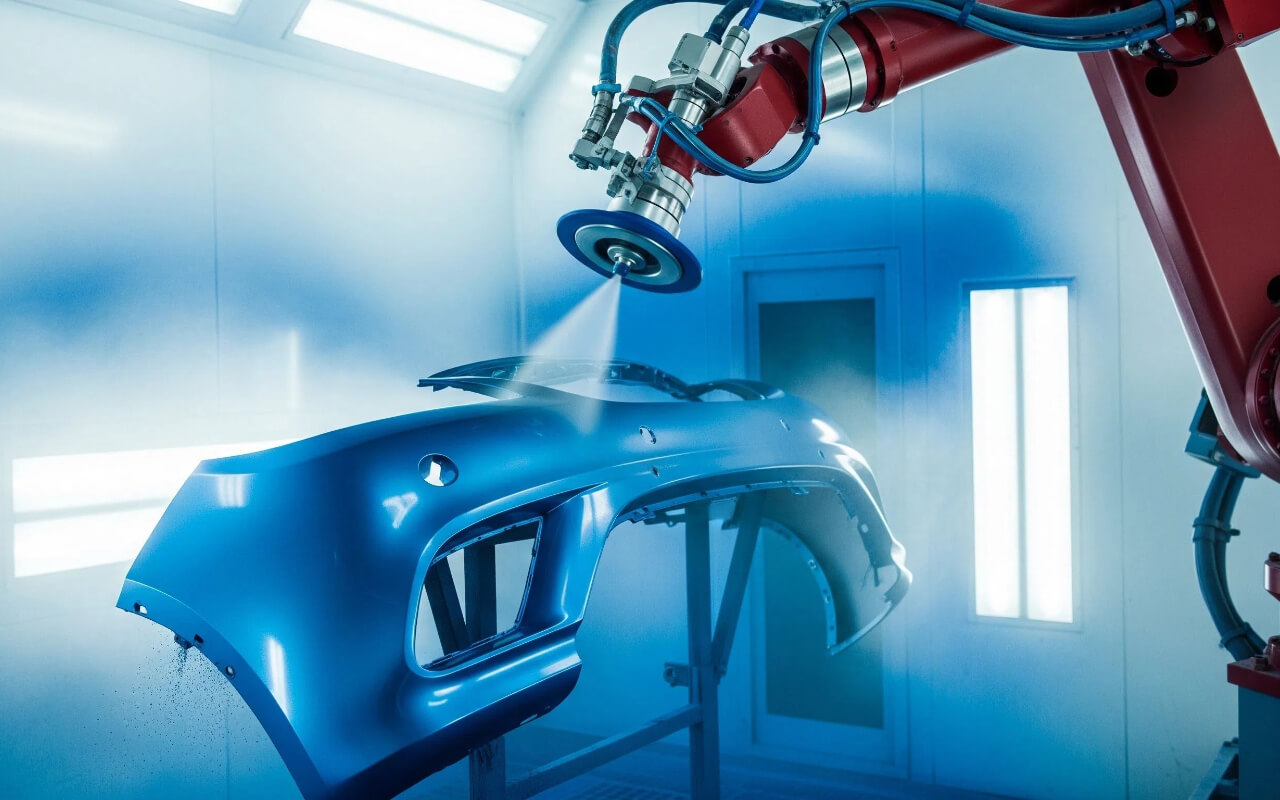
High-voltage electrostatic spray robots are widely used in automotive painting operations. One of the core technical indicators for judging their performance is transfer efficiency during spraying. Currently, painting of bumper resin parts suffers from low conductivity of the resin material and irregular shapes, resulting in low coating adherence and material waste during the painting of resin parts. Starting from practical factory improvements and applications, this paper introduces the definition and measurement method of transfer efficiency for electrostatic spraying of resin parts, studies advanced electrostatic spraying technologies and key technical parameters used in the automotive industry, and identifies key technologies and optimization methods to improve transfer efficiency, offering suggestions for building a resource-efficient, environmentally friendly society.
Keywords: high-voltage electrostatic spraying, transfer efficiency, bumper resin parts
Robots are a priority development area identified in "Made in China 2025." In the coating industry, compared with conventional spraying equipment, electrostatic spray robots have gradually become one of the most widely used industrial robots—particularly in automotive production—because they can effectively reduce paint usage, lower waste emissions, and cut production costs.
01 Electrostatic rotary cup spraying method
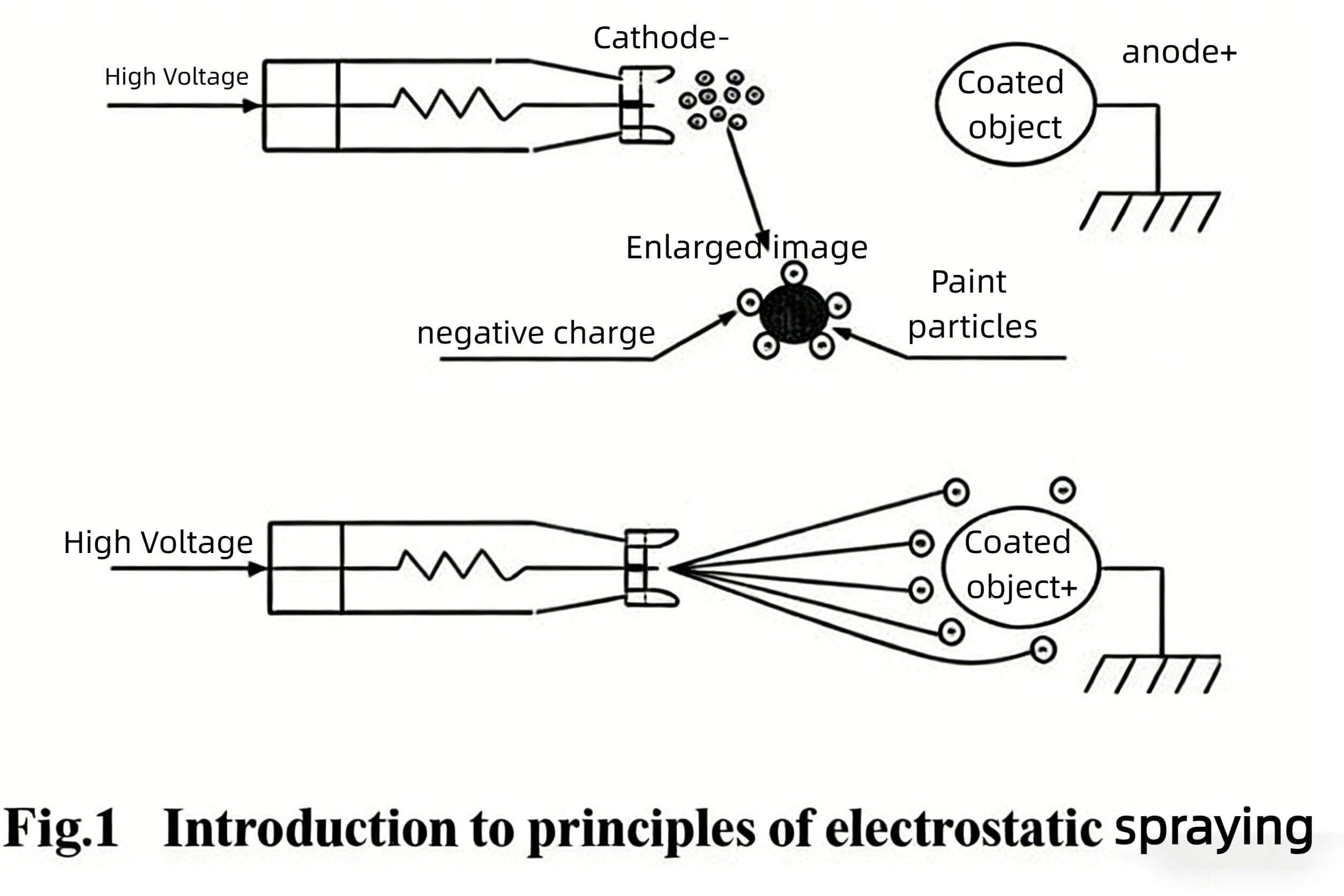
Robot electrostatic spraying is an efficient spraying method based on the basic properties of like charges repelling and opposite charges attracting. The workpiece to be coated is normally grounded and serves as the anode, while the spray gun nozzle is at a negative high voltage. When paint particles acquire charge passing through the gun, they become charged particles and, under the high-voltage electrostatic field, move toward and adhere to the oppositely charged workpiece surface, forming a uniform coating.
02 Principle of electrostatic rotary cup spraying and equipment composition
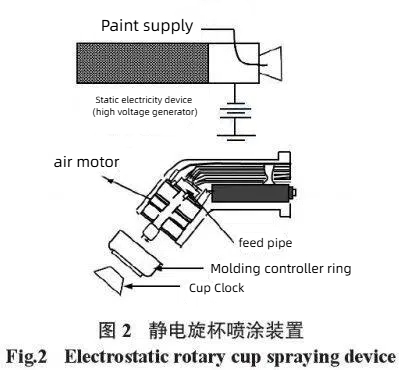
To ensure surface gloss on automobiles and improve transfer efficiency, the automotive painting industry has recently developed a new universal electrostatic rotary cup spray robot. By controlling key parameters during spraying, it achieves both high decorative quality and high transfer efficiency. High-speed rotation atomizes the paint into fine particles, and electrostatic force makes those particles adhere to the workpiece surface. Compared with air spraying, this can greatly increase transfer efficiency. An electrostatic rotary cup spray robot mainly consists of the rotating atomizing head (cup), high-speed rotary bearing (air motor), paint nozzle (feed line), air unit to control spray pattern, high-voltage generator, etc.. Spraying motions are typically precisely controlled by six-axis robots and are suitable for large and complex-shaped workpieces.
03 Transfer efficiency measurement method
Transfer efficiency is a core technical indicator for evaluating static spray robot performance. Transfer efficiency is the ratio of paint actually adhered to the workpiece to the paint used in the spraying process. Measurement of transfer efficiency for bumper parts is influenced by measurement tools and environment, producing significant variation under different conditions. The calculation formula is:
Transfer efficiency = (weight of dried coated film on workpiece (B − A) g / amount of paint used C g × dilution NV) × 100
Single measurements of transfer efficiency for resin parts may vary; typically 3–5 measurements are taken and the average result is used to determine the typical spraying efficiency for the product.
3.1 Current status of transfer efficiency
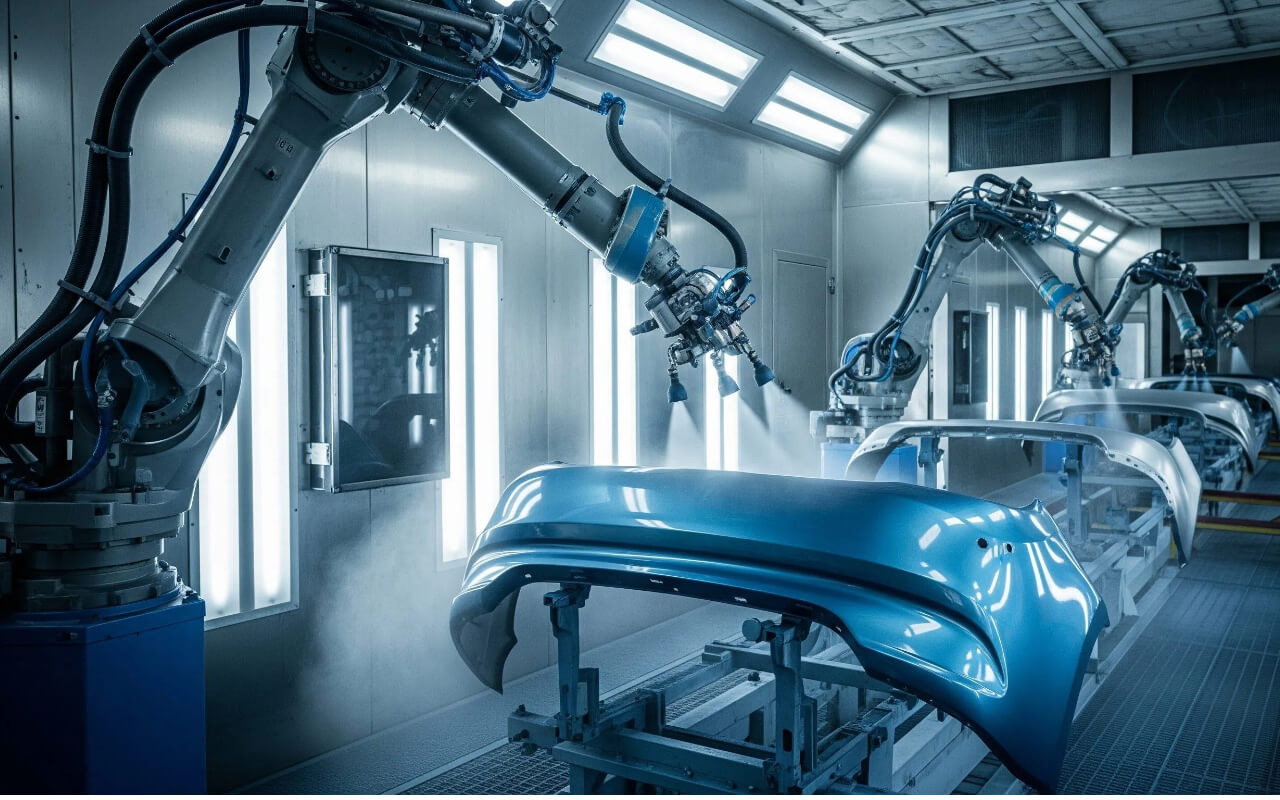
Advanced domestic and international automotive paint shops—such as Mercedes-Benz, Volkswagen, Great Wall, and Geely—commonly use ABB RobotBe1951 variable fan-width rotary-cup electrostatic spray robots. Combining factory production data and laboratory tests comparing transfer efficiency of rotary-cup electrostatic guns, it was found that under the same equipment parameters, transfer efficiency differs greatly between vehicle bodies and plastic bumpers.
04 Factors affecting transfer efficiency of resin bumpers and directions for improvement
4.1 Grounding condition of the workpiece
Electrostatic spraying relies on electrostatic attraction: the grounded workpiece acts as the positive electrode while the paint atomizer (spray cup or disk) is connected to high negative voltage. The quality of grounding of the workpiece directly affects spraying efficiency. In factory production, poor grounding frequently causes surface appearance defects and unsatisfactory perceived quality.
Because poor grounding significantly affects transfer efficiency of resin bumpers, the grounding condition of bumper parts should be comprehensively considered during process design to ensure good grounding. Typically, conductive clips or conductive plates are used to connect plastic bumpers to fixtures to improve transfer efficiency. The condition of conductive clips or plates should be monitored regularly during production, and resistance measurements performed when necessary to ensure proper grounding. In some factories, due to inconvenience of manually applying grounding clips, automated solutions such as robotic riveting are being introduced; these both ensure grounding and reduce manual labor, improving automation while maintaining quality.
4.2 Key technical parameters
When optimizing spraying parameters, the goal is to ensure the appearance of resin parts—uniform, consistent film thickness—while also meeting production cadence and transfer efficiency targets. The key parameters affecting transfer efficiency in electrostatic rotary-cup spraying are: high-voltage electrostatic pressure, gun distance, gun speed, fan air pressure, flow rate (output), and fan width—six critical technical indicators .
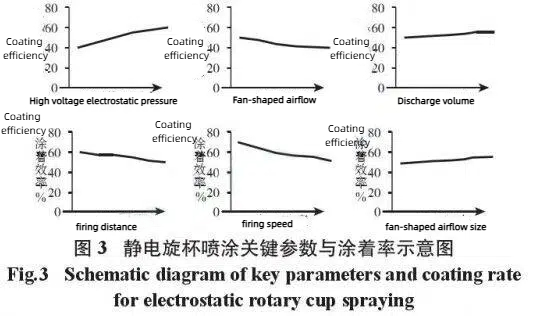
When optimizing these parameters to increase transfer rate, one should evaluate them together rather than individually. For example, higher electrostatic voltage generally increases transfer efficiency, but because resin bumpers have low conductive grounding, increasing high voltage can produce excessive current between the gun and bumper that causes discharge hazards. Typically, the high-voltage electrostatic setting for resin bumpers is around −60 kV. Tests on transfer rate under various combinations of the six parameters show that the most effective way to improve transfer efficiency—while maintaining voltage, speed, and distance—is to optimize three parameters: fan width, fan air pressure, and flow rate. High fan air pressure creates vortices on the bumper surface that scatter paint particles into the air, reducing transfer efficiency (see Figure 4); reducing fan air pressure should be a priority improvement.
4.3 Trajectory optimization for edges and openings
Existing gun models are mainly suitable for perpendicular spraying. When planning spray trajectories for bumper surfaces with irregular edge geometries, besides spray inclination angle, one must consider spray height, fan width, and gun speed among other controllable parameters. Ignoring curved boundary shapes in trajectory design leads to overspray. Improvements to inclination angle and spray point positioning (see Figure 5) can greatly increase transfer efficiency in opening areas while preserving film-thickness quality. Film-thickness distribution at a 40° inclination is shown in Figure 6.
When spraying edges, consider gun on/off delay. Trajectory design should account for the gun’s spray range and minimize frequent on/off cycles to reduce delay effects and thereby improve transfer efficiency.
4.4 Paint conductivity
In production, differences in paint conductivity significantly affect spraying efficiency and coating quality. Paint conductivity depends on the dry-film conductivity of the paint itself and on primer dry-film thickness. Thicker coatings increase conductivity and thus improve electrostatic spraying efficiency; however, thicker primer layers raise production costs and increase the risk of sagging. Therefore, finding a suitable balance between production economy and quality is critical.
05 Conclusion

In the context of rapid growth in the automotive industry, it is necessary to consider both appearance and film-thickness requirements and production cost. Improving transfer efficiency in spraying is one of the most effective technical measures to save resources, reduce costs, lower hazardous-waste emissions, and meet environmental standards. For example, on a production line with annual capacity of 100,000 sets of plastic painted parts, where paint accounts for about 70% of material cost and per-unit cost is 300 CNY/set, a 20% increase in transfer efficiency would save approximately 6 million CNY per year in paint costs alone—excluding VOC treatment expenses—making it highly significant for cost reduction and efficiency improvement.


