

 English
 Español
 Português
 Русский
 عربي
عربي Türkçe
 Deutsch
 Polski
 Français
 Italiano
 Tiếng Việt
Engineering Design of Power and Free Conveyor Systems in Automotive Manufacturing

The Power and Free (P&F) conveyor system is a highly functional and flexible workpiece handling solution. Beyond mere transportation, it excels at the classification and buffer storage of diverse components, making it indispensable in modern industrial production. This article explores the engineering design of a P&F conveyor system, using a specific automotive welding workshop as a case study.
Keywords: Power and Free Conveyor, Systems Engineering, Design, Production Automation, Automotive Manufacturing.
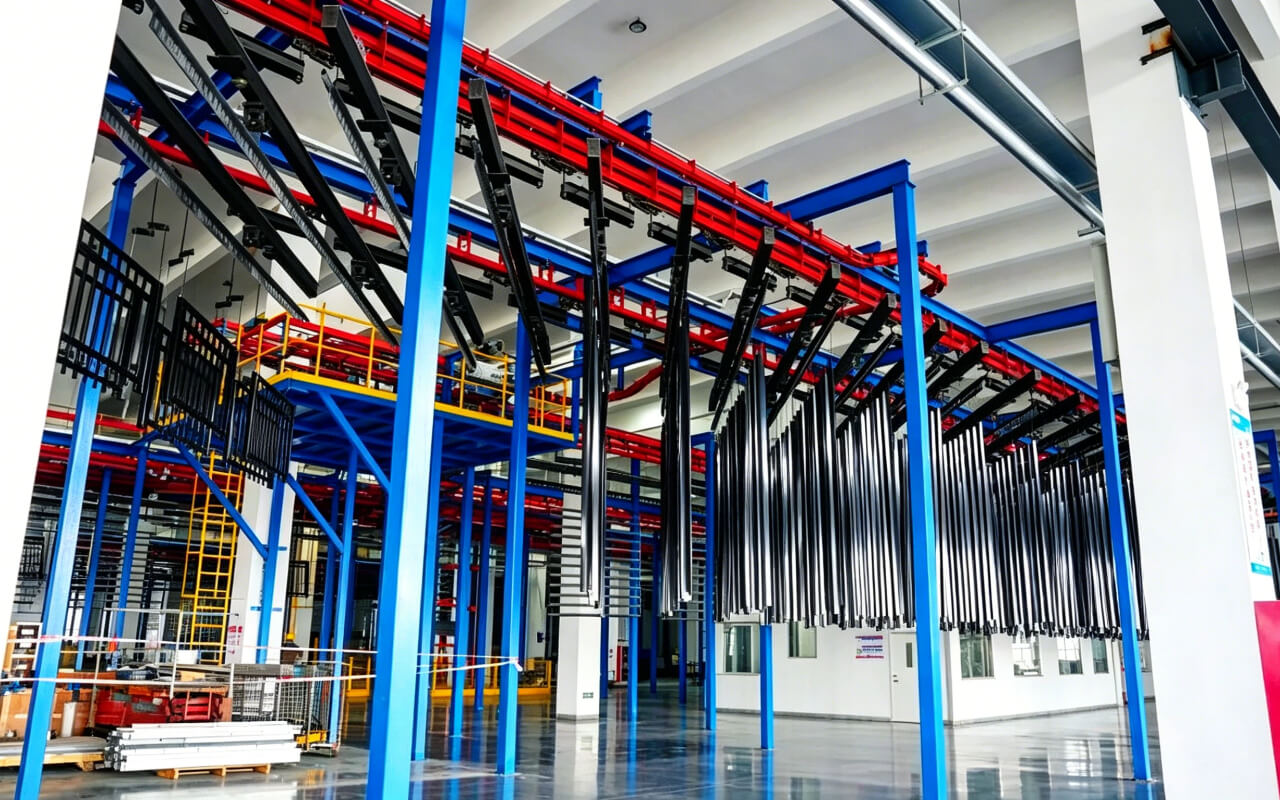
1. Project Overview and Process Requirements
1.1 Production Capacity
The system is designed to support high-volume output across two primary lines:
Line A: 90,000 units (double shift).
Line B: 50,000 units (double shift).
Total System Capacity: 140,000 units annually.
Maximum Payload: 500 kg per Body-in-White (BIW).
1.2 Process Workflow
The conveyor manages the transition of the BIW from the welding stage to the painting stage:
Loading Station: Qualified BIWs from the welding line are transferred onto P&F pendants.
Accumulation/Storage Area: Different BIW models are sorted and stored in designated zones.
Main Conveyor Line: Transports the BIWs from storage toward the paint shop.
Unloading Station: Transfers the BIW from the P&F pendant onto the paint shop skids.
1.3 Architectural Integration
The facility utilizes a light steel structure. Technical loads are distributed across a 3m x 8m grid, with each suspension point designed to support a 4.5t vertical load and a 0.8t horizontal load.
2. System Layout and Equipment Selection
A robust P&F system consists of loading lifters, conveyor tracks, storage zones, unloading lifters, and an integrated electronic control system.
2.1 Loading and Unloading Lifters
Loading: Lifters at Lines A and B use a lifting roller bed to position the BIW. Once the P&F stopper opens, an empty carrier is locked via a pin-positioning device. The lifter descends, placing the BIW onto the carrier before returning to the home position.
Unloading: The carrier is locked at the unloading lifter. The lifter rises to lift the BIW off the carrier. Telescopic forks then transfer the body onto the paint shop roller bed skids.
2.2 Conveyor Route and Storage
The system features approximately 2,000 meters of track powered by six independent drive stations.
Product Flexibility: Since welding and painting sequences often differ, the system includes three dedicated storage lines (20 units each) to sort three distinct car series.
Fast Track: A "bypass" lane allows priority BIWs to move directly to the paint shop without entering accumulation zones.
3. Structural Features and Technical Specifications
The system utilizes a 4-inch heavy-duty wide-push-head P&F overhead conveyor. Key components include:
3.1 Drive and Tensioning Units
Caterpillar Drive: Uses a linear drive with a large arc guide plate to minimize chain surging and ensure smooth traction. Features variable frequency speed control and mechanical overload protection.
Pneumatic Tensioner: A roller-supported floating frame with an 800mm stroke absorbs chain slack. It includes limit switches for over-travel protection.
3.2 Chain and Trolley Assembly
Chain: X-458 standard drop-forged rivetless chain (45Mn2 material). Breaking load: 216kN; Allowable tension: 15kN.
Trolleys: Precision-cast steel trolleys (front, middle, and rear) equipped with buffer linkages. These allow for smooth accumulation (stopping the carrier while the chain continues to run) without damaging the workpieces.
3.3 Track and Switches
Track Construction: A combination of I10 beam (for the power chain) and 4-inch special channel steel (for the trolley).
Switches: Diversion switches (controlled by PLC via pneumatic cylinders) manage route selection, while merging switches operate via "spring-push" mechanics.
4. Electronic Control System (ECS) Design
The control architecture is built for high availability and automated synchronization.
4.1 Hardware Architecture
Core Controller: Siemens S7-series PLC.
Network: Ethernet for high-level data and Profibus-DP for fieldbus communication between the Main Control Panel (MCP), Remote Control Panels (RCP), and operator stations.
HMI: Touchscreens are deployed at key stations for real-time monitoring and rapid fault diagnostics.
4.2 Operational Logic
The system supports three distinct modes:
Automatic: Full-line synchronization for production.
Semi-Automatic: Controlled sequence flow.
Maintenance: Manual control of lifters and stoppers for commissioning and repair.
4.3 Safety and Integration
Safety First: Emergency stop buttons are networked; the system requires a "Fault Reset" after any trigger before resuming.
Cross-Workshop Sync: The PLC exchanges data with both the welding and painting workshops to ensure the "Pull" signal from painting is met with the correct BIW model from the storage buffer.
Conclusion
Modern automotive P&F systems have evolved beyond simple transport. By integrating sophisticated mechanical design with PLC-driven automation, these systems achieve seamless, worker-free transitions between manufacturing stages, providing the flexibility required for multi-model co-line production.


