 English
 Español
 Português
 Русский
 عربي
عربي Türkçe
 Deutsch
 Polski
 Français
 Italiano
 Tiếng Việt
Paint Line Chain Rail: Light-Duty or Heavy-Duty?
I. Why Is Rail Selection So Critical?
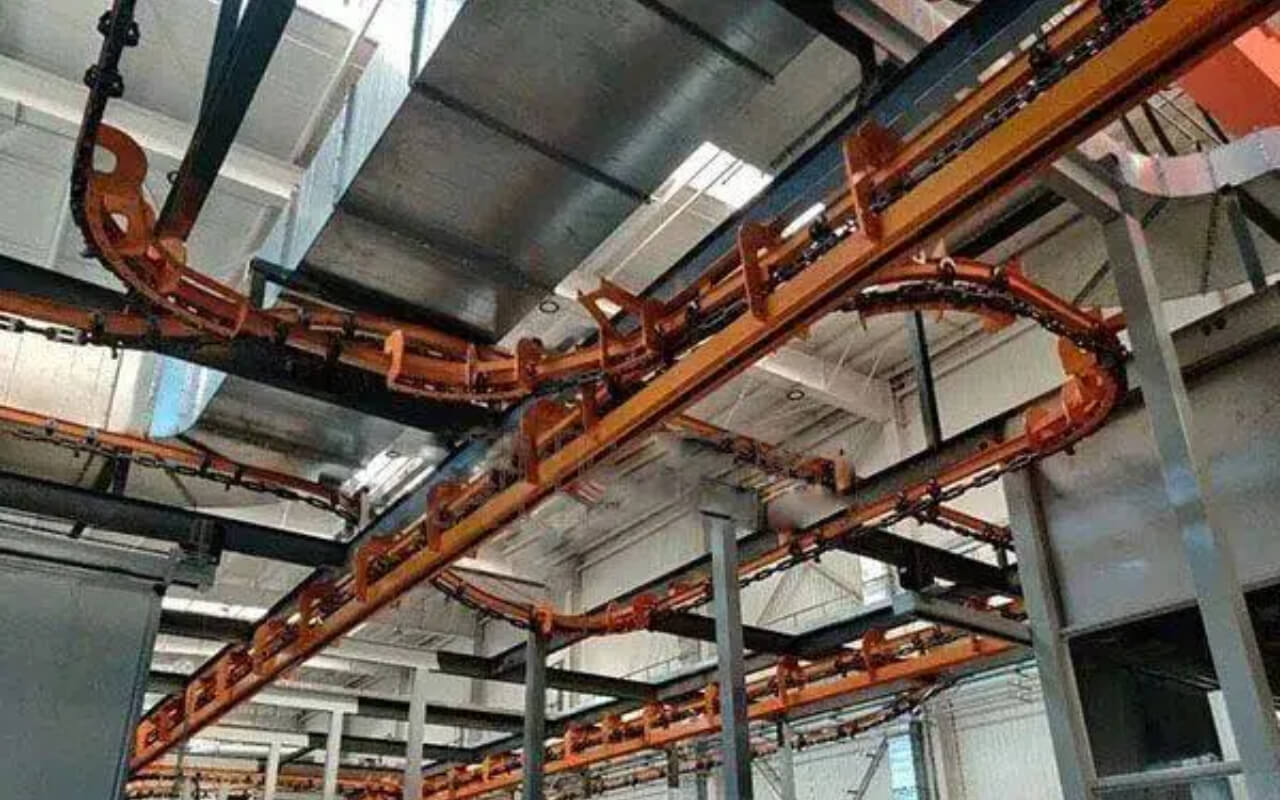
The chain rail is the "backbone" of a paint line's overhead conveyor system, directly determining:
① Load-bearing safety — insufficient rail capacity can cause deformation, chain jamming, or even derailment; ② Operating stability — light-duty rail overloaded with heavy parts causes high vibration, noise, and faster sprocket wear; ③ Investment cost — heavy-duty rail material costs 60%–120% more than light-duty; over-specifying wastes money; ④ Maintenance cycle — improper selection can shorten rail life from 15 years to 3–5 years; ⑤ Future retrofit — once installed, replacing rail requires shutting down the entire line, making retrofit costs very high.
Typical lesson learned: A home-appliance factory built a new paint line and, to save money, chose light-duty rail (30 kg single-point capacity). After a product upgrade increased part weight to 38 kg, the rail showed severe wear and frequent chain derailing after only 8 months of operation. The plant was forced to shut down the entire line and replace it with heavy-duty rail — retrofit cost plus production-loss totaled over CNY 1.2 million, far exceeding the original savings from choosing light-duty rail.
II. Light-Duty vs. Heavy-Duty Rail: Basic Definitions
Light-Duty Chain Rail
Definition: Overhead conveyor chain rail with single-point load capacity ≤ 50 kg.
Typical models:
| Model | Pitch (mm) | Single-point load (kg) | Rail cross-section |
|---|---|---|---|
| XT80 | 76.2 | 15–20 | C-channel steel 80×50 |
| XT100 | 76.2 | 30–35 | C-channel steel 100×50 |
| 3" universal chain | 76.2 | 30–50 | I-beam steel 100×68 |
Typical applications: Conveying for paint coating of household appliance shells, hardware parts, lighting fixtures, plastic parts, and other light, small workpieces.
Heavy-Duty Chain Rail
Definition: Overhead conveyor chain rail with single-point load capacity ≥ 50 kg (typically 125–500 kg+).
Typical models:
| Model | Pitch (mm) | Single-point load (kg) | Rail cross-section |
|---|---|---|---|
| XT160 | 101.6 | 50–75 | I-beam steel 126×74 |
| 4" universal chain | 101.6 | 125–150 | I-beam steel 150×100 |
| 6" accumulation chain | 153.2 | 250–500 | Special channel steel 200+ |
Typical applications: Conveying for paint coating of automotive bodies, large structural components, construction-machinery parts, and other heavy workpieces.
III. Rail Cross-Section Structure Comparison
The diagram compares a light-duty C-channel rail (100×50 mm cross-section, chain running inside the channel) against a heavy-duty I-beam rail (150×100 mm cross-section, with separate load-bearing and guiding flanges).
Key structural difference: Light-duty C-channel rail has its opening facing downward, with the chain rollers running inside the flange — simple in structure but lower in bending stiffness. Heavy-duty I-beam rail uses the upper flange for load-bearing and the lower flange for guidance, giving far greater bending stiffness and load capacity, suitable for long unsupported spans and heavy-load conditions.
IV. 12 Key Metrics — Full Comparison
| Comparison item | Light-duty rail | Heavy-duty rail |
|---|---|---|
| Single-point load | 15–50 kg | 50–500+ kg |
| Chain pitch | 76.2 mm (3") | 101.6/153.2 mm (4"/6") |
| Rail cross-section | C-channel steel 80–100mm | I-beam steel 126–200mm+ |
| Rail wall thickness | 3–5 mm | 5–8 mm |
| Max. unsupported span | 1.5–2.0 m | 2.5–4.0 m |
| Max. running speed | 15–25 m/min | 5–15 m/min |
| Min. curve radius | R400–600 mm | R800–1500 mm |
| Unit weight (kg/m) | 5–10 | 12–30 |
| Design life | 8–12 years | 15–25 years |
| Rail unit price (CNY/m) | 80–150 | 180–400 |
| Lubrication method | Manual / automatic oiling | Automatic oiling (standard) |
| Typical noise level | 65–72 dB(A) | 58–65 dB(A) |
V. Load Capacity and Safety Factor
The core of rail selection is load verification — it cannot be decided by rough estimation.
Load verification formula:
Single-point load P = (workpiece weight + fixture/hanger weight) × safety factor
Safety factor selection rules:
- Uniform, stable load (e.g., fixed cycle time, consistent workpieces): k = 1.3–1.5
- Loads with impact or off-center loading (e.g., swinging during loading/unloading): k = 1.5–2.0
- Curing oven section (reduced material strength at high temperature): k = 1.8–2.5
Example: Workpiece 25 kg + fixture 5 kg = 30 kg; safety factor for the curing oven section taken as 2.0 → Single-point load P = 30 × 2.0 = 60 kg → Light-duty rail (XT100, single-point 30–35 kg) does not satisfy this — XT160 or 4" universal chain must be used.
Selection rule of thumb: P ≤ 80% of the rail's rated load capacity
VI. Matching Running Speed to Cycle Time
The paint line's production cycle time directly determines the required chain speed. Different rail types vary significantly in their suitability for different speeds:
| Production cycle | Line speed (m/min) | Light-duty rail | Heavy-duty rail | Typical industry |
|---|---|---|---|---|
| 2–4 min/hanger | 0.5–2.0 | ✅ Fully capable | ✅ Fully capable | Automotive bodies |
| 1–2 min/hanger | 2.0–5.0 | ✅ Capable | ✅ Capable | Auto parts |
| 30–60 s/hanger | 5.0–12.0 | ✅ Capable | △ Somewhat fast | Appliances / hardware |
| 15–30 s/hanger | 12.0–25.0 | ✅ Optimal range | ❌ Too fast, not recommended | Small hardware / lighting fixtures |
Key point: Heavy-duty rail chains have greater mass and inertia, so at high speed the braking distance is longer and impact force is greater. If the production cycle is fast (<30 s/hanger), heavy-duty rail is not the better choice — it can actually become a bottleneck. High speed favors light-duty; heavy loads favor heavy-duty — each has its own optimal application range.
VII. Curve Negotiation Comparison
Paint lines typically include multiple curves (loading/unloading zones, oven entry/exit, process transitions), and curve radius directly affects rail selection.
Comparing the same-angle curve, light-duty rail (R=500mm) takes up less floor space and allows flexible layout, while heavy-duty rail (R=1200mm) requires a larger curve footprint — roughly 2.5–4 times the floor area of light-duty rail for the same curve angle.
VIII. Cost Comparison Analysis
Rail selection cost should not be judged only by "price per meter of rail" — the full life-cycle cost, including support structure, installation, and maintenance, must be calculated.
Full life-cycle cost estimate (100 m straight section, 10-year operating period):
Light-duty rail (XT100, C-channel 100×50):
- Rail material: 100m × ¥120/m = ¥12,000
- Chain + fittings: ≈ ¥28,000
- Support structure (one set per 1.5m): ≈ ¥15,000
- Installation: ≈ ¥8,000
- Annual maintenance (lubrication + wear parts): ≈ ¥3,000/year
- 10-year total cost = 12,000+28,000+15,000+8,000+3,000×10 = ¥93,000
Heavy-duty rail (4" universal chain, I-beam 150×100):
- Rail material: 100m × ¥280/m = ¥28,000
- Chain + fittings: ≈ ¥55,000
- Support structure (one set per 2.5m): ≈ ¥18,000
- Installation: ≈ ¥12,000
- Annual maintenance (lubrication + wear parts): ≈ ¥2,000/year
- 10-year total cost = 28,000+55,000+18,000+12,000+2,000×10 = ¥123,000
Over a 10-year period, heavy-duty rail costs roughly 32% more than light-duty rail. However, heavy-duty rail can last 15–25 years, so when amortized, the annual cost gap narrows considerably.
IX. Respective Pros and Cons
(Summary chart referenced in original — not reproduced here as table content was image-based)
X. Selection Decision Tree
(Decision-tree diagram referenced in original — not reproduced here as content was image-based)
XI. Real-World Case References
Case 1: Auto-parts manufacturer (light-duty → heavy-duty upgrade)
- Situation: Overhead conveyor line; original workpiece 18 kg + fixture 6 kg = 24 kg, using XT100 light-duty rail
- Change: Product upgrade increased workpiece weight to 42 kg + fixture 8 kg = 50 kg
- Problem: XT100's rated capacity is 35 kg; 50 kg exceeded this by 43%. Severe flange wear appeared after only 6 months of operation
- Retrofit: Replaced the entire line with XT160 (I-beam, single-point capacity 75 kg)
- Retrofit cost: Rail + chain + supports ≈ ¥280,000, with 10 days of production downtime
- Lesson: Had XT160 been chosen from the start, the additional cost would have been only about ¥50,000 — far less than the retrofit cost
Case 2: Home-appliance factory (successful high-speed light-duty rail application)
- Situation: AC unit shell paint line; workpiece 8 kg + fixture 2 kg = 10 kg, cycle time 20 s/hanger
- Selection: XT80 light-duty rail (C-channel 80×50, single-point capacity 20 kg)
- Result: Running speed 18 m/min, stable operation for 7 years, chain wear within normal range
- Economics: Total investment ~35% lower than a heavy-duty solution, with low average annual maintenance cost
Case 3: Construction-machinery manufacturer (heavy-duty accumulation chain application)
- Situation: Excavator frame paint line; workpiece 280 kg + fixture 45 kg = 325 kg
- Selection: 6" accumulation chain (rail 200+ special channel steel, single-point capacity 500 kg)
- Features: Oven section span of 3.5 m at 200°C; heavy-duty rail's bending strength fully meets requirements
- Result: Running speed 2.5 m/min, stable operation for 12 years, virtually no rail deformation
- Note: Curve radius R=1500mm — requires a large factory floor footprint
XII. Common Selection Misconceptions
| Misconception | Reality |
|---|---|
| "Heavy-duty rail is better quality — always choose heavy-duty" | Over-specifying wastes 30%–60% of investment; heavy-duty is actually unsuitable for high-speed scenarios |
| "Light-duty rail is cheap — just make it work for now" | Overloading → rapid wear → forced replacement → total cost far exceeds choosing heavy-duty from the start |
| "Only consider workpiece weight, ignore fixture weight" | Fixture weight ranges 5–45 kg; omitting it leads to undersized rail selection |
| "A safety factor of 1.0 is fine" | High oven temperatures reduce steel strength by 15%–20% — a margin must be included |
| "The smaller the curve radius, the more space saved" | Too-small curve radius → severe chain side wear → lifespan reduced by more than 50% |
XIII. Summary and Recommendations
| Scenario | Recommended rail type | Core reason |
|---|---|---|
| Workpiece + fixture ≤ 30 kg, cycle < 30s | Light-duty (XT80/XT100) | Sufficient capacity, fast speed, lower investment |
| Workpiece + fixture 30–50 kg | Light/heavy transition zone (3" universal chain / XT160) | Must be judged based on oven temperature and cycle time together |
| Workpiece + fixture 50–150 kg | Heavy-duty (4" universal chain) | Matches load requirements, smooth operation |
| Workpiece + fixture > 150 kg | Heavy-duty accumulation chain (6") | Determined by load requirements, no alternative |
| Oven section (temp > 180°C, span > 2m) | Heavy-duty rail required | Reduced high-temp strength + large span deflection |
| Future product upgrades may increase weight | Reserve one size up | Upgrade cost is far lower than retrofit cost |
Engineer's final recommendations:
① Calculate load first, then consider cycle time — load is a hard constraint, cycle time is a soft constraint;
② Never skimp on the safety factor — use 1.8–2.5 for oven sections, 1.3–1.5 for ambient-temperature sections;
③ Reserve one size of margin — if there are plans for future product upgrades, choose one size larger immediately;
④ Check the oven section separately — carbon steel's yield strength drops by about 15% at 200°C, requiring a separate calculation;
⑤ Err toward a larger curve radius — for every 20% reduction in radius, chain side wear increases by about 40%.
Bottom line: Don't over-specify with heavy-duty rail where light-duty can do the job — but never force light-duty rail onto a load it can't handle.