

 English
 Español
 Português
 Русский
 عربي
عربي Türkçe
 Deutsch
 Polski
 Français
 Italiano
 Tiếng Việt
What Are the Main Conveying Systems Used in Automotive Painting Lines?

Automotive painting conveying systems refer to the mechanized solutions used on coating production lines to carry, transport, and transfer vehicle bodies (or components) through various process stages—such as pretreatment, electrocoating (e-coating), painting, and curing. Often described as the "arteries" of a paint shop, these systems directly impact production efficiency, product quality, and capital investment.
Based on transport space and process characteristics, automotive paint conveying systems are broadly divided into overhead conveying systems and floor conveying systems, with several specialized variants developed for key process stages.
1. Overhead Conveying Systems
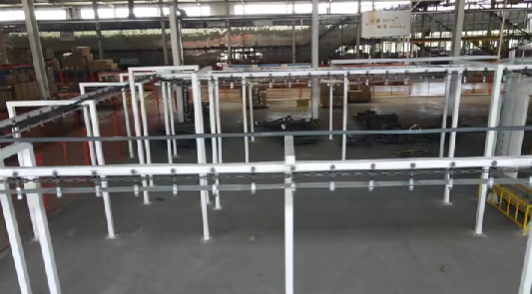
Overhead conveyors are installed above the workshop or on elevated structures, allowing vehicle bodies to be suspended in the air during transport. This approach is primarily used in pretreatment and e-coating lines, as it facilitates full immersion in treatment tanks while minimizing contamination.
Key Types of Overhead Conveyors
1. Power & Free Conveyor (Push Rod Type)
Working Principle: Composed of a traction chain, carriers, hangers, and rails; allows stopping and accumulation at any point.
Core Features: Mature technology, low investment, easy manufacturing; however, higher load on slopes and risk of rollback.
Applications: Early-stage systems or cost-sensitive pretreatment and e-coating lines.
2. Pendulum Conveyor (Swing Arm Type)
Working Principle: Uses a U-shaped swing arm to carry the vehicle body, mounted on chains on both sides, enabling oscillation between tanks.
Core Features: Large immersion angle (up to 45°), shorter equipment length, and reduced contamination from chain oil drips.
Applications: High-volume production lines with stringent quality requirements.
3. RoDip Conveyor (Rotary Dip Conveyor)
Working Principle: Specialized tracks guide skids to rotate vehicle bodies 360° during transport for reverse immersion.
Core Features: Exceptional process performance, eliminates air bubbles on roofs, shortest line length; requires high structural strength at locking points.
Applications: High-end passenger vehicle paint shops with single-model, large-scale production.
4. Continuous Rotation Dip System
Working Principle: Uses dedicated mechanical mechanisms to continuously rotate and immerse the vehicle body during movement.
Core Features: Stable operation and optimized chemical reactions in treatment baths through controlled motion.
Applications: Modern pretreatment and e-coating lines.
2. Floor Conveying Systems
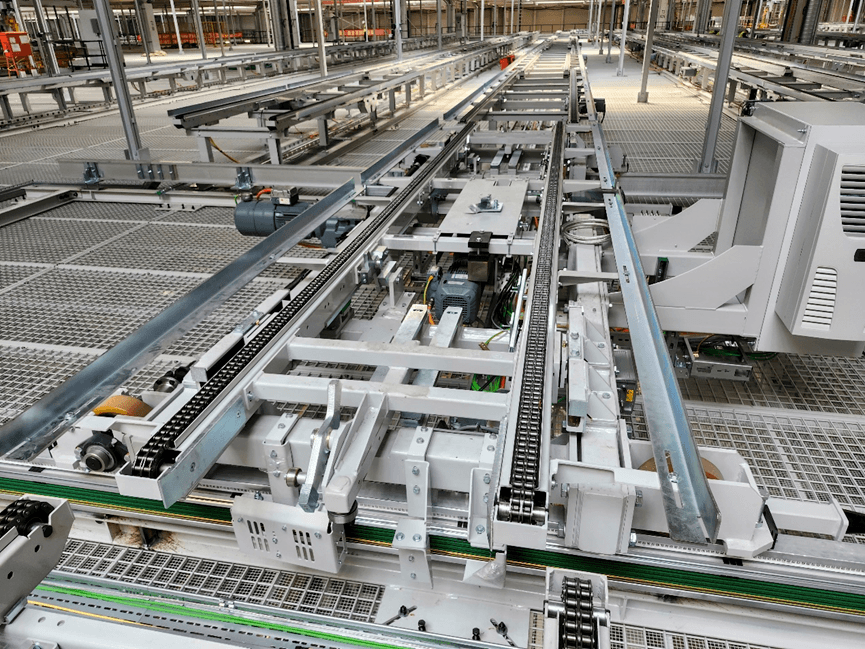
Floor conveyors are installed at ground level, with vehicle bodies carried on skids or carts. These systems are widely used in post-e-coating processes such as sealing, painting, curing, and rework.
Key Types of Floor Conveyors
1. Skid Conveyor System
Working Principle: Composed of standard modules such as roller beds, transfer units, and lifts; uses friction to move skids along tracks.
Core Features: High flexibility, easy speed switching, automation-friendly, and modular scalability; the most widely used system today.
Applications: Nearly all processes after e-coating, including sanding, sealing, painting, curing, and inspection.
2. Friction Conveyor System
Working Principle: Friction wheels directly contact and press against rails to drive carts.
Core Features: Simple structure, low noise; commonly adopted by some Japanese manufacturers.
Applications: Specific OEM paint shops or assembly lines.
3. Intelligent Shuttle / AGV Systems
Working Principle: Independently controlled programmable shuttles run on tracks, or Automated Guided Vehicles (AGVs) operate without fixed tracks.
Core Features: Highly flexible control, optimized immersion angles and speeds for different vehicle models, enabling smart manufacturing.
Applications: Mixed-model production lines and highly flexible modern paint shops.
3. Advanced and Emerging Conveying Technologies
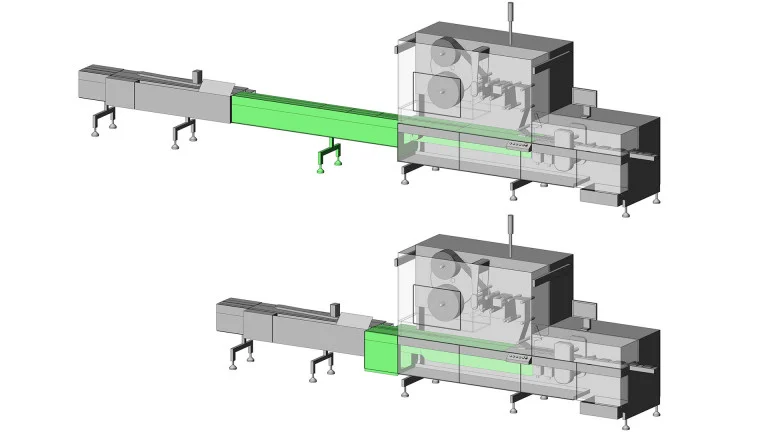
To meet increasing demands for quality and flexibility, several advanced technologies are gaining traction:
1. Parallel Mechanism Conveyors
Combine traveling systems with parallel kinematics to enable lifting, tilting, and compound motions (e.g., forward/backward + inclination).
Enhance liquid agitation, eliminate air bubbles, and provide high load capacity and flexibility.
2. Magnetic Drive Conveyor Systems
Use electromagnetic force for contactless drive or even levitation.
Offer extreme flexibility (software-defined paths and takt times), high positioning accuracy, low maintenance, and ultra-clean operation.
Represent a key future direction for intelligent paint shops, though high initial investment and limited large-scale heavy-duty applications remain challenges.
Conclusion
Selecting the right automotive paint conveying system requires a comprehensive evaluation of vehicle type, production volume, quality requirements, investment budget, and plant layout:
Pretreatment & E-coating Lines: Focus on achieving optimal liquid penetration and contamination control (e.g., pendulum conveyors, RoDip systems, or shuttle systems).
Topcoat & Post-process Lines: Emphasize flexible transport, precise positioning, and efficient buffering (e.g., skid systems, AGVs, or magnetic drive systems).
In practice, modern automotive paint shops integrate multiple conveying technologies to optimize process flow and maximize economic efficiency—delivering both high quality and high productivity in increasingly complex manufacturing environments.


