

 English
 Español
 Português
 Русский
 عربي
عربي Türkçe
 Deutsch
 Polski
 Français
 Italiano
 Tiếng Việt
What Is the Principle of UV Curing? A Complete Guide to Ultraviolet Light Curing Technology

I. Definition of UV Curing
UV (ultraviolet) curing is a photochemical process in which photoinitiators (photosensitive agents) are exposed to ultraviolet light, triggering the formation of excited molecular states that decompose into free radicals or ions. These reactive species then initiate polymerization, grafting, and crosslinking reactions among unsaturated organic compounds, ultimately achieving rapid curing.
Managing Infrared Radiation from UV Lamps
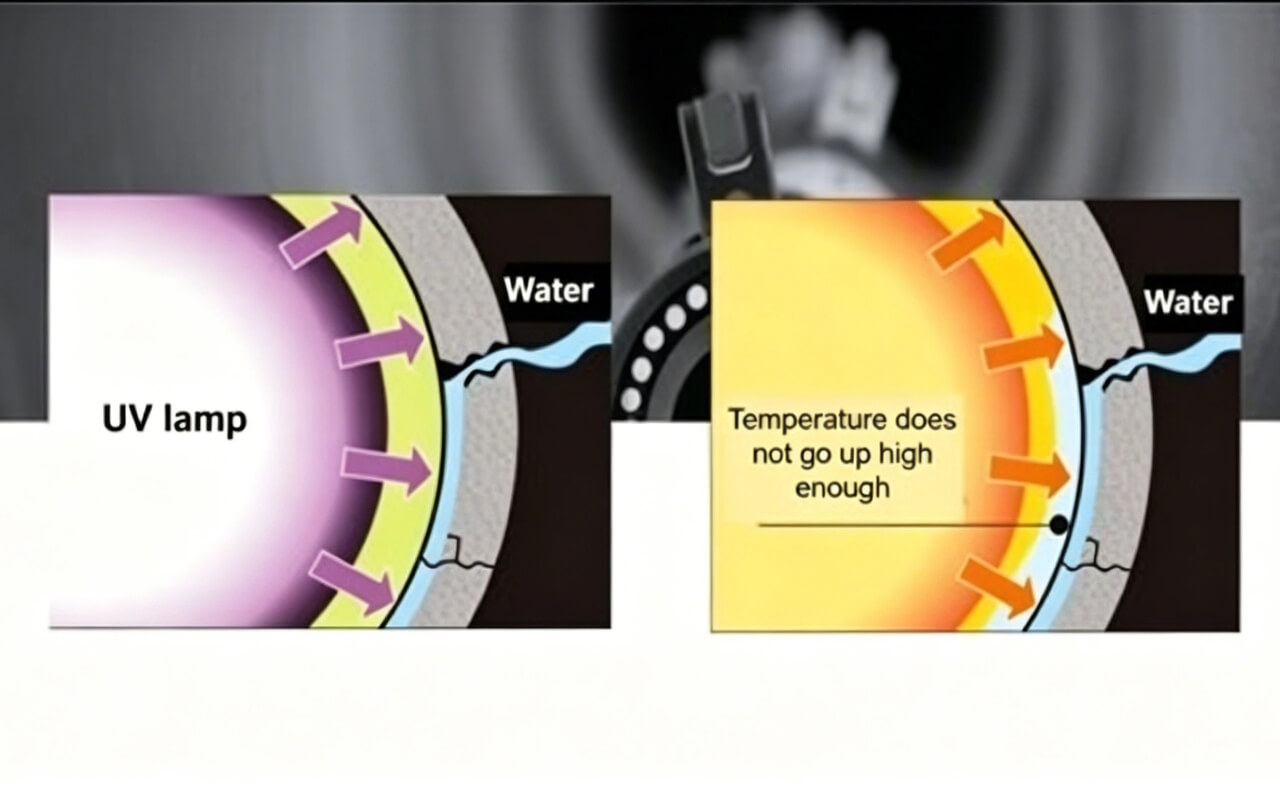
High-pressure mercury UV lamps convert approximately 60% of their total input power into infrared (IR) radiation, causing lamp surface temperatures to reach 700–800°C. To prevent heat damage to substrates, modern UV curing systems—especially those using high-power lamps or multiple lamp setups—incorporate various cooling strategies for the lamp, reflector, and substrate.
In UV coating applications, careful temperature control is essential: overheating must be avoided, yet a moderate temperature rise in the coating layer is beneficial for curing efficiency. Three common approaches are used:
Air Cooling – The most widely used method due to its low cost.
Water Cooling – A water jacket surrounds the lamp tube, offering high cooling efficiency but at a higher cost.
Optical Filtering – Optical elements isolate IR radiation from the curing area, ideal for heat-sensitive or easily deformable products.
The Role of Reflectors
Adding a reflector maximizes the UV intensity directed onto the substrate. The reflector’s efficiency directly affects curing quality. Using full-mirror reflective inserts inside the reflector can improve UV light utilization by 30–40% compared to standard reflectors, directing over 90% of the lamp’s UV output onto the product surface and significantly boosting productivity.
II. Key Factors Influencing Deep UV Curing

After UV exposure, photoinitiators in the coating generate free radicals or ions. These react with double bonds in prepolymers or unsaturated monomers, forming monomer radicals that initiate chain reactions, ultimately producing solid polymer networks. The following factors critically affect deep curing performance:
1. UV Energy Delivery
Effective deep curing requires that molecules absorb sufficient photon energy to become excited and generate reactive species. The UV energy supplied must match the photoinitiator’s requirements:
Sufficient energy – Slightly exceeding the required energy ensures complete curing.
Excessive energy – Wasted energy can cause over-curing effects such as explosive polymerization or reverse reactions.
Insufficient energy – Leads to incomplete curing, with tacky or under-cured surfaces.
Thus, precise UV energy dosing is essential.
2. Coating Thickness
Coating thickness plays a decisive role in curing quality:
Overly thick coatings – Require longer exposure times, slowing drying, increasing substrate temperature, and risking thermal deformation.
Overly thin coatings – Result in poor surface gloss.
Optimal thickness depends on the coating’s color, temperature, curing speed, and substrate characteristics, and must be adjusted accordingly.
3. Curing Distance
The distance between the UV lamp/reflector and the substrate surface is typically 10–15 cm, although the maximum UV intensity occurs at 7–8 cm.
Too close – High surface temperatures may deform heat-sensitive substrates.
Too far – Reduced UV energy leads to tacky or uncured surfaces.
The ideal distance must be optimized based on the substrate, coating formulation, and lamp power.
4. Curing Speed
Curing speed (line speed) should be adjusted according to the substrate, coating, and curing distance:
Excessively fast – Results in a tacky surface or a skin that cures while the underlying layer remains uncured.
Excessively slow – May cause surface degradation or aging.
Proper speed calibration ensures thorough, uniform curing without defects.


