 English
 Español
 Português
 Русский
 عربي
عربي Türkçe
 Deutsch
 Polski
 Français
 Italiano
 Tiếng Việt
How to Build an Automotive Paint Booth?
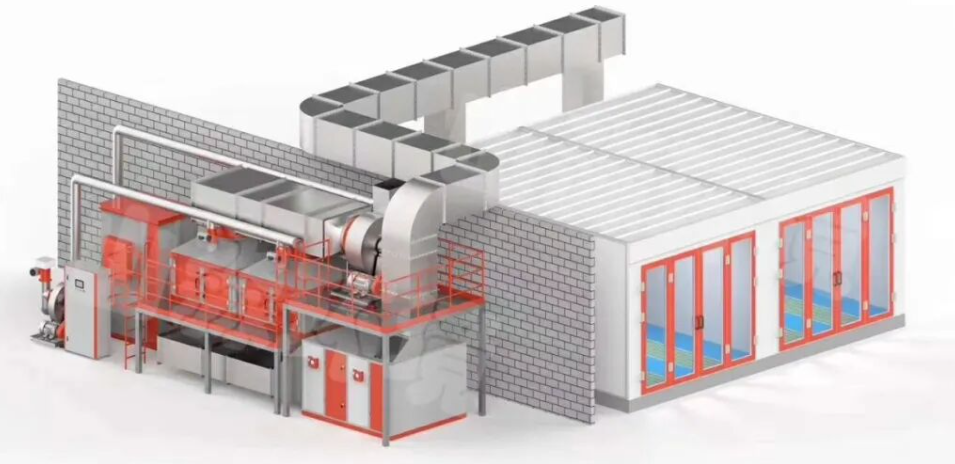
A Comprehensive Guide to Technical Measures for Coating Workshops
Introduction: Building a high-quality automotive paint booth (coating workshop) requires a delicate balance of environmental compliance, coating quality, and operational safety. This comprehensive guide outlines the technical measures, core parameters, and implementation workflows required to construct electrostatic, robotic, and high-temperature baking paint booths for modern automotive manufacturing.
1. Core Objectives and Strategic Positioning
1.1 Core Objectives
The primary goal is to build an "environmentally compliant, high-quality, and operationally safe" paint booth system. This addresses common industry pain points such as incomplete paint mist collection, VOC emission violations, and unstable coating quality.
The construction must comply with key industry standards, including:
Design Code for Automotive Coating Workshops (JB/T 13097)
Safety Technical Regulations for Spray Booths (GB 14444)
Standard for Fugitive Emission of Volatile Organic Compounds (GB 37822)
Target Metrics:
Paint mist collection rate: ≥98%
VOC emission concentration: ≤60mg/m³
Post-construction coating pass rate: ≥99%
1.2 Precision Positioning
The project design is driven by a balance between capacity scale, environmental requirements, and coating quality. It focuses on specific application scenarios (electrostatic, robotic, and high-temperature booths) and process characteristics (low VOCs, high-precision spraying, rapid curing).
By implementing a technical closed-loop system—"Needs Analysis → Parameter Adaptation → Process Control → Effect Verification"—the booth construction will perfectly align with the production rhythm of the coating workshop, effectively avoiding environmental penalties and coating defects caused by improper installation.
2. Paint Booth Types and Application Scenarios
2.1 Electrostatic Paint Booths (For Small/Medium Batch Production)
Core Specifications: Constructed with Class A fireproof rock wool color steel panels (thickness ≥50mm). Features epoxy self-leveling flooring (solvent-resistant, thickness ≥2mm). Equipped with electrostatic spraying equipment (Voltage: 60-100kV; Current: ≤50μA) and a multi-tier filtration system (Primary + Medium + High-efficiency, efficiency ≥98%).
Application Scenario: Ideal for truck cabs and special vehicle bodies.
Key Metrics: Standard size is 6m × 4m × 3.5m. Construction cycle: ≤15 days/booth. Paint mist collection: ≥98%; Coating thickness deviation: ≤±5μm.
2.2 Robotic Automatic Paint Booths (For Mass Sedan Production)
Core Specifications: Enclosed with 304 stainless steel panels (thickness ≥1.5mm, surface roughness Ra≤0.8μm). Floors are paved with galvanized carbon steel grating (load-bearing ≥500kg/㎡). Equipped with 6-axis painting robots (repeatability ≤±0.05mm, working radius 1.8-2.2m). Features a Venturi paint mist capture system (efficiency ≥99%) and a Regenerative Thermal Oxidizer (RTO) for incineration (VOC removal ≥95%).
Application Scenario: High-volume sedan body coating.
Key Metrics: Standard size is 12m × 5m × 4m. Construction cycle: ≤30 days/booth. VOC emissions: ≤60mg/m³; Spraying efficiency: ≥90%.
2.3 High-Temperature Baking Booths (For Coating Curing)
Core Specifications: Built with heat-resistant color steel panels (aluminum silicate core, heat resistance ≥200℃). Features a gas heating system (heating rate 5-10℃/min, temp range 80-180℃), a hot air circulation system (wind speed 0.5-1m/s, temp uniformity deviation ≤±3℃), and explosion relief devices (relief area ≥0.05㎡/m³).
Application Scenario: Curing processes for automotive bumpers, wheel hubs, and other components requiring high temperatures.
Key Metrics: Standard size is 8m × 4m × 3.8m. Construction cycle: ≤20 days/booth. Temp control accuracy: ±2℃; Post-cure coating adhesion: ≥5MPa.
3. Core Parameters and Compliance Standards
3.1 Core Technical Parameters
General Parameters: Operating temperature is 18-25℃ (spraying zone) and 80-180℃ (baking zone). Humidity: 40-60%. Air exchange rate: ≥20 times/h (spraying) and ≥15 times/h (baking).
Environmental Parameters: Paint mist collection rate: ≥98% (Electrostatic) / ≥99% (Robotic). VOC emission concentration: ≤60mg/m³. RTO removal rate: ≥95%.
Safety Parameters: Explosion-proof grade: Ex d IIB T4 (Gas baking booths). Grounding resistance: ≤4Ω. Fire system response time: ≤30s. Workshop noise level: ≤85dB.
3.2 Compliance Standards
Environmental: VOC emissions meet GB 37822. Paint mist filter residues are managed as hazardous waste (GB 18597).
Safety: Electrical equipment protection grade is IP54 (spraying zone) / IP55 (baking zone). Explosion-proof facilities meet GB 50160.
Quality: Coating thickness deviation ≤±5μm, adhesion ≥5MPa, with no visible defects such as sagging or pinholes (GB/T 13452.2).
4. Implementation Workflow and Methodology
4.1 Pre-Construction Preparation
Needs & Site Analysis: Confirm coating components, capacity (e.g., 50 sedans/day), paint type (solvent/water-based), and curing requirements to finalize booth dimensions. Conduct site surveys to verify installation space (aisles ≥2m), floor load-bearing capacity (≥800kg/㎡ for robotic booths), and utility connections (380V/50Hz power, 0.1-0.2MPa gas pressure, 0.6-0.8MPa compressed air).
Resource Allocation: Assemble certified construction and quality inspection teams. Procure materials (panels, spray equipment, RTO, explosion-proof lighting) backed by quality and environmental certifications.
4.2 Construction Execution Workflow
A. Electrostatic Paint Booth Construction:
Enclosure & Floor: Assemble steel panels with sealant to prevent mist leakage. Install explosion-proof observation windows (≥8mm) and interlocked safety doors. Pour concrete base (flatness ≤±2mm/2m) and apply epoxy flooring (curing ≥48h).
Equipment & Electrical: Mount electrostatic sprayers (300-500mm from workpieces). Install multi-tier filter pads. Connect explosion-proof lighting, ventilation fans (1-1.5m/s), and exhaust ducts to the factory's environmental system.
B. Robotic Automatic Paint Booth Construction:
Enclosure & Floor: Weld 304 stainless steel panels (polished to Ra≤0.8μm) and secure galvanized gratings (spacing ≤20mm).
Robotics & Environmental Systems: Secure robot bases (levelness deviation ≤±0.02mm/m) and calibrate trajectories. Install the Venturi capture system (wind speed 2-3m/s). Hoist and seal the RTO incinerator (combustion temp 800-850℃, residence time ≥2s).
Joint Debugging: Connect the PLC control system to synchronize robot spraying with the workpiece conveyor line.
C. High-Temperature Baking Booth Construction:
Enclosure & Heating: Assemble aluminum silicate panels using high-temp sealant (≥200℃). Install explosion relief windows (pressure ≤0.1MPa). Mount gas burners with flame detectors and install circulation fans to ensure uniform heat distribution.
Temp Control & Safety: Place temperature sensors (1 per 2㎡) connected to a precision controller (±2℃). Install explosion-proof lighting, combustible gas detectors (alarm ≤25% LEL), and an automated fire suppression system (sprinkler + dry powder).
4.3 Acceptance and Handover
Validation: Ensure all quality metrics (paint collection, VOCs, temp/humidity accuracy) meet standards. Obtain third-party environmental test reports and pass official fire safety inspections.
Documentation: Deliver signed and traceable blueprints, equipment manuals, environmental reports, and maintenance guides.
Training & Support: Conduct comprehensive training for operational staff (equipment use, parameter adjustment, maintenance). Provide 1-year technical support, including scheduled quarterly environmental tests and routine troubleshooting.