

 English
 Español
 Português
 Русский
 عربي
عربي Türkçe
 Deutsch
 Polski
 Français
 Italiano
 Tiếng Việt
The Impact of Temperature and Humidity on Water-Based Paint Application and Film Quality
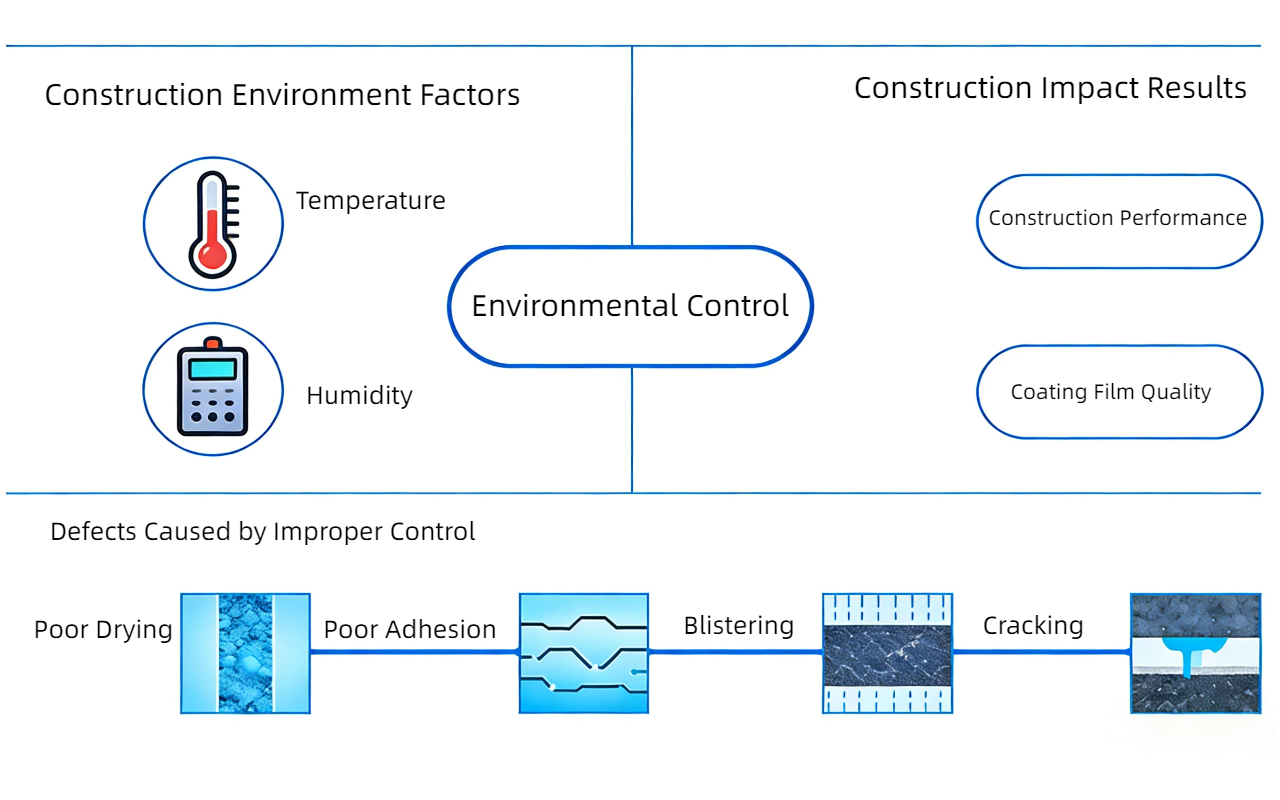
The performance and final finish quality of water-based coatings are strictly governed by the ambient temperature and humidity during application. Improper environmental control can lead to critical defects such as poor drying, weak adhesion, blistering, and cracking.
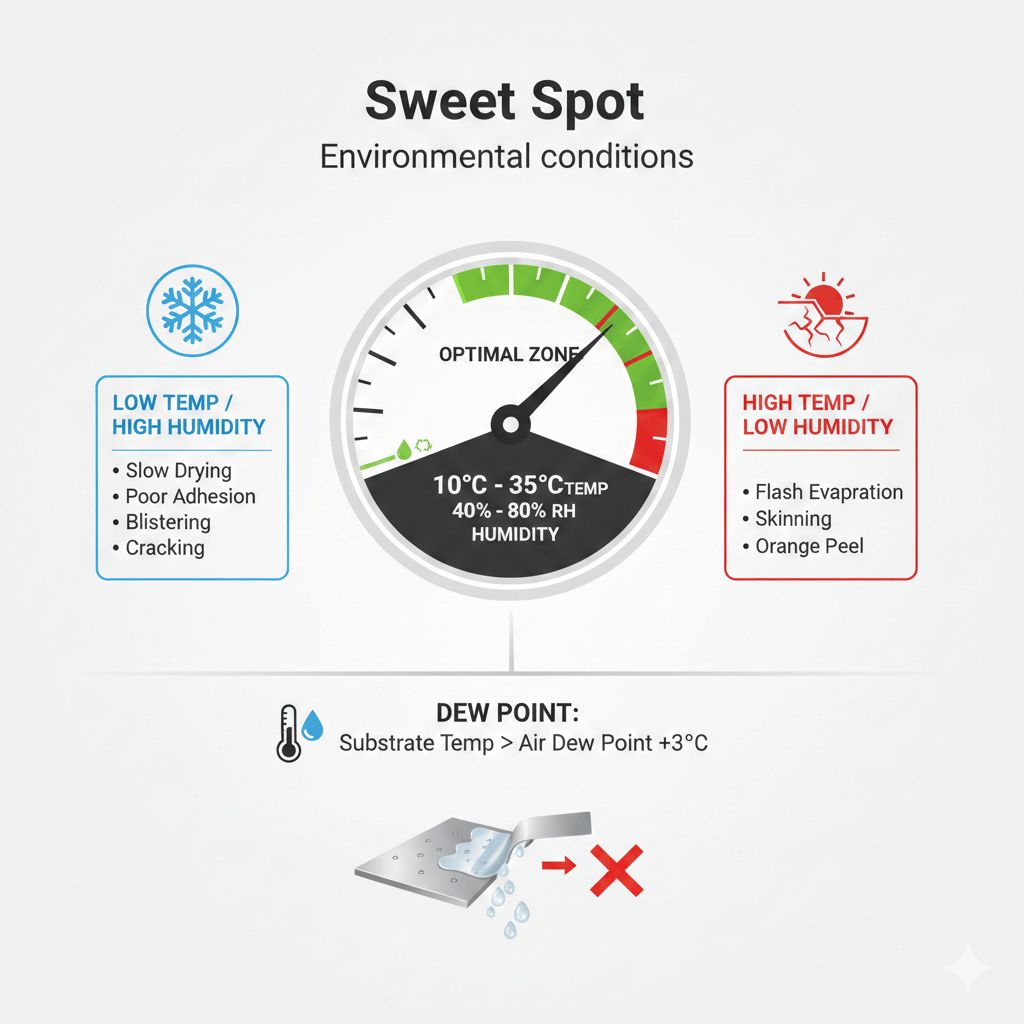
Essential Factors: Temperature & Humidity
Environmental conditions dictate two critical processes: moisture evaporation and film-forming chemical reactions.
1. The Role of Temperature
Optimal Range: Generally between 10°C and 35°C.
Low Temperatures (< 5-10°C):
Evaporation slows down significantly, preventing the paint from drying.
If the temperature falls below the Minimum Film-Forming Temperature (MFFT), the polymer emulsion cannot fuse into a continuous, dense film.
For two-component coatings (e.g., Waterborne Epoxy or Polyurethane), chemical curing may slow down or stop entirely.
High Temperatures (> 35°C):
Flash evaporation causes the surface to "skin over" while moisture remains trapped inside, leading to blistering and cracking.
Poor leveling occurs as the paint dries too fast, resulting in brush marks and pinholes.
2. The Role of Humidity
Optimal Range: Ideal Relative Humidity (RH) is between 40% and 80%.
High Humidity (RH > 80-85%):
Air saturation prevents evaporation, multiplying drying times.
Trapped condensation creates pores in the film, drastically reducing corrosion resistance and mechanical strength.
In polyurethanes, isocyanates react with moisture to produce $CO_2$, causing microscopic pinholes.
Low Humidity (RH < 40%):
Extreme drying speeds prevent the coating from leveling out, leading to low gloss and reduced adhesion.
The Critical Indicator: Dew Point
When working outdoors or in fluctuating environments, the Dew Point is more vital than temperature or humidity alone. It is the temperature at which water vapor begins to condense into liquid water.
The Golden Rule: The substrate surface temperature must be at least 3°C higher than the current air dew point.
Why? If the surface is at or near the dew point, an invisible film of water forms on the substrate. Coating over this moisture traps water under the paint, inevitably leading to adhesion loss, blistering, and flash rust.
Key Controls for Successful Application
Monitor Consistently: Use hygrometers and dew point meters before, during, and after application.
Climate Control: Utilize HVAC, dehumidifiers, or space heaters to maintain the specified range.
Substrate Preparation: Ensure the metal or wood is clean, dry, and at the correct temperature.
Adjust Technique: In sub-optimal conditions, apply multiple thin coats rather than one thick layer to ensure thorough through-drying.
Summary: High-performance water-based coating results require precision control of temperature, humidity, and dew point. Always consult the Technical Data Sheet (TDS) and perform a test patch before full-scale production.
Keywords: Water-based coatings, Industrial Painting, Paint Film Defects, Dew Point Calculation, Coating Quality Control, ShengTai Painting Equipment.
#WaterborneCoatings #PowderCoating #IndustrialPainting #SurfaceFinishing #ManufacturingExcellence #ShengTaiEquipment #QualityControl #PaintingTips


