 English
 Español
 Português
 Русский
 عربي
عربي Türkçe
 Deutsch
 Polski
 Français
 Italiano
 Tiếng Việt
The Ultimate Guide to Aluminum Finishes: Powder Coating vs. PVDF

As we all know, aluminum profiles have relatively poor surface adhesion. If paint is sprayed directly onto an aluminum surface, it is difficult to achieve good adhesion; even if it barely sticks, it will peel off quickly. So, how can we improve this adhesion? The solution is to apply a primer layer to the aluminum substrate to enhance paint adhesion before applying the topcoat. Today, we will walk you through the standard operating procedures for aluminum alloy coating.
Coating is generally divided into powder coating and liquid coating, among which fluorocarbon (PVDF) coating is currently one of the most popular processes in the industry.
01 Electrostatic Powder Coating Process
01 Principle
Powder coating involves placing powder coating materials into a spray gun. Under the force of compressed air, high-voltage static electricity causes the powder particles to adhere to the surface of the aluminum profile. This is also known as electrostatic powder coating.
This coating makes the product's surface flat, smooth, and uniform in color, while providing exceptional resistance to acids, alkalis, impacts, and wear. It can withstand intense ultraviolet radiation and acid rain erosion for extended periods without experiencing chalking, fading, or peeling.
02 Pros and Cons
Advantages:
(1) Highly efficient and energy-saving: Because the film is formed in a single application, it can increase productivity by 30-40% and reduce energy consumption by about 30%.
(2) Eco-friendly: There is no volatilization of organic solvents (it does not contain harmful gases like toluene and xylene found in liquid paints).
(3) Excellent coating performance: A single application can achieve a film thickness of 50-80μm, and its comprehensive indicators, such as adhesion and corrosion resistance, are outstanding.
(4) Diverse colors: Various colors can be customized according to customer requirements, with a very low probability of color variation (color difference).
Disadvantages:
(1) Brighter colors are more prone to fading over time.
(2) If the profile surface is not well-prepared, it can easily lead to an "orange peel" effect or even powder shedding.
03 Process Flow
(1) Surface Pretreatment:
For sheet metal stamping parts, chemical pretreatment can be used. The steps are: Degreasing → Derusting → Washing → Phosphating (or Passivation), etc. For workpieces with heavy rust or thick surface scaling, mechanical methods like sandblasting or shot blasting are used for derusting. However, after mechanical derusting, the workpiece surface must be perfectly clean and free of scale.
(2) Spraying:
The workpiece enters the spray gun position in the powder coating booth via a conveyor chain to prepare for spraying. The electrostatic generator releases high-voltage static electricity (negative pole) into the space toward the workpiece through the electrode needle at the spray gun nozzle. This high voltage ionizes the mixture of powder and compressed air ejected from the nozzle, as well as the air around the electrode (giving them a negative charge). The workpiece is grounded through the hanger and conveyor chain (acting as the grounding pole). This creates an electric field between the spray gun and the workpiece. Driven by both the electric field force and compressed air pressure, the powder reaches the workpiece and relies on electrostatic attraction to form a uniform coating on its surface.
(3) Baking and Curing:
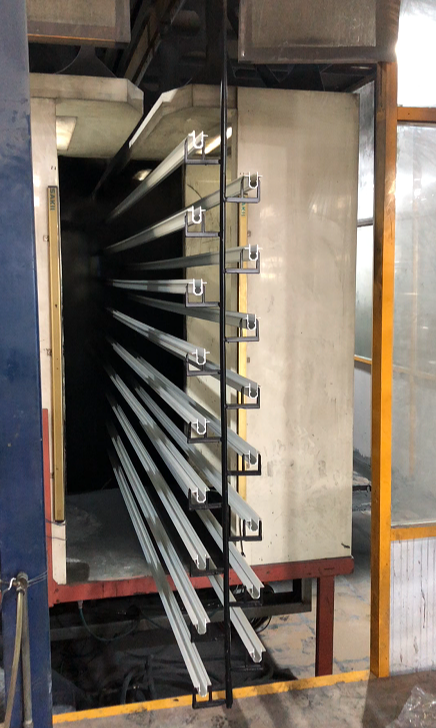
The sprayed workpiece is sent via the conveyor chain into a baking oven heated to 180–200°C. It is kept at this temperature for a specific amount of time (15-20 minutes) to allow the powder to melt, level, and cure, thereby achieving the desired surface finish. (Note: Different powders require varying baking temperatures and times, which must be strictly observed during the curing process).
02 Fluorocarbon (PVDF) Coating
01 Principle
Fluorocarbon coating is a type of electrostatic spraying that utilizes liquid paint. In Hong Kong, this process is often referred to as "baked enamel" (锔油). It is classified as a high-end coating process, hence its higher price, and has been widely used internationally for a long time.
02 Process Flow
Pretreatment flow: Aluminum degreasing and decontamination → Water wash → Alkaline wash (degreasing) → Water wash → Acid wash → Water wash → Chromating → Water wash → Pure water wash.
Coating flow: Primer application → Topcoat application → Clear coat (varnish) application → Baking (180-250°C) → Quality Inspection.
Multi-layer coating processes generally consist of a three-coat system (primer, topcoat, and clear coat) or a two-coat system (primer and topcoat).
(1) Purpose of Pretreatment: Before spraying aluminum alloy profiles and plates, the workpiece surface must be degreased, cleaned, and chemically treated to generate a chromate film. This increases the adhesion between the coating and the metal surface and enhances anti-oxidation capabilities, which helps extend the lifespan of the paint film.
(2) Primer Coating: As the base layer sealing the substrate, its purpose is to improve the coating's penetration resistance, enhance substrate protection, stabilize the metal surface layer, and strengthen the adhesion between the topcoat and the metal surface. It also ensures the color uniformity of the topcoat. The primer thickness is generally 5-10 microns.
(3) Topcoat Coating: The topcoat is the crucial layer of the spray coating. It provides the required decorative color for the aluminum, allowing the appearance to meet design standards. It also protects the metal surface from the external environment, atmospheric conditions, acid rain, and pollution, while preventing UV penetration. It significantly enhances anti-aging capabilities. The topcoat is the thickest paint layer, generally ranging from 23-30 microns.
(4) Clear Coat (Varnish) Coating: The main purpose of the clear coat is to effectively enhance the paint layer's resistance to external erosion, protect the topcoat, and increase the metallic luster of the topcoat's color, making the appearance more vivid and dazzling. The clear coat thickness is generally 5-10 microns. The total thickness of a three-coat system is typically 40-60 microns (can be thickened for special requirements).
(5) Curing Treatment: A three-coat system generally requires secondary curing. The aluminum is processed in a curing oven, with temperatures generally between 180°C and 250°C and a curing time of 15-25 minutes. Different fluorocarbon coating manufacturers will provide optimal temperatures and times based on their specific formulas. Based on their own experience, some fluorocarbon coating factories modify the standard two curing cycles of a three-coat system into a single curing cycle.
03 Pros and Cons
Advantages:
(1) Weather resistance: Highly resistant to UV degradation and chalking, maintaining its color and gloss over the long term.
(2) Chemical resistance: Resistant to erosion from acids and liquid alkalis, and remains unaffected by air pollution and acid rain.
(3) Corrosion resistance: Low permeability to corrosive particles in the air, allowing it to withstand harsh environments for a long time without corroding.
(4) Mechanical properties: Excellent impact resistance, wear resistance, and superior flexibility of the paint film.
Disadvantages:
(1) High cost.
(2) Prone to the "orange peel" effect if not processed properly.