 English
 Español
 Português
 Русский
 عربي
عربي Türkçe
 Deutsch
 Polski
 Français
 Italiano
 Tiếng Việt
What is Powder Coating Line? How Do It Work?
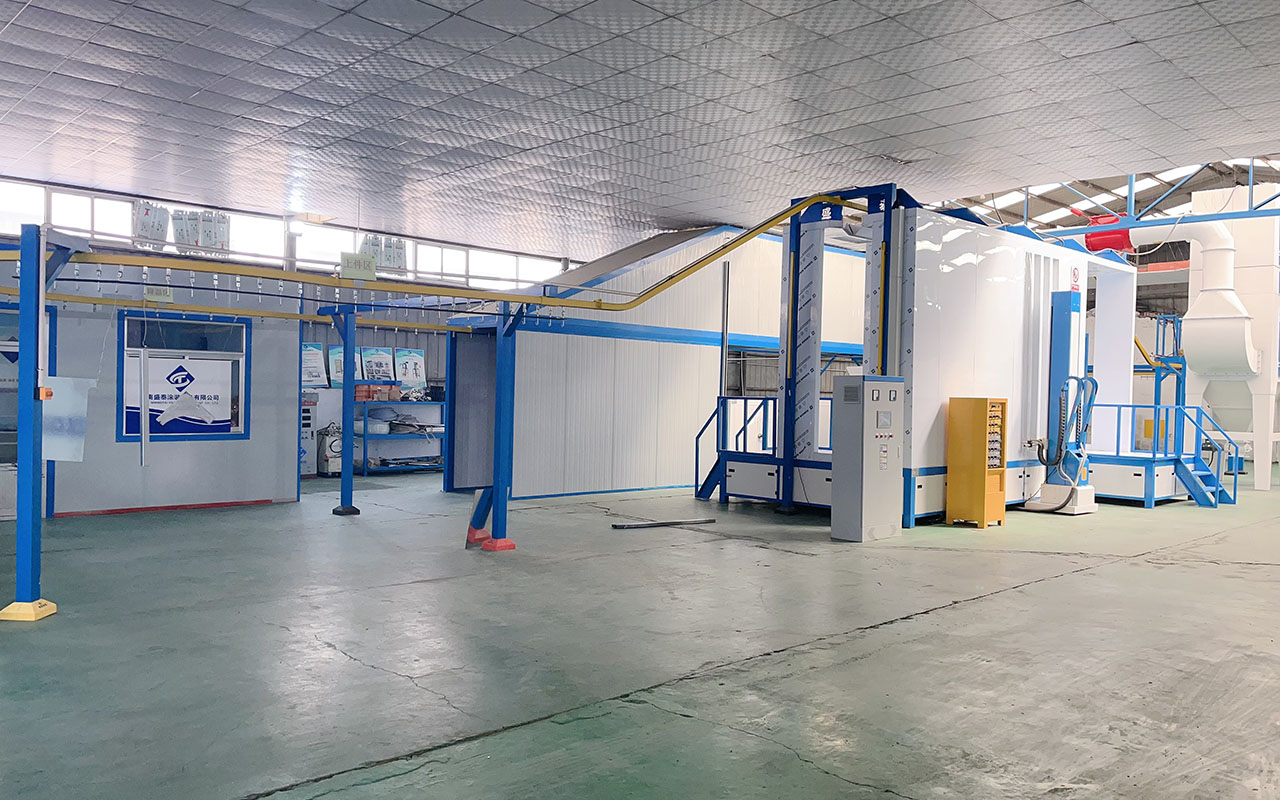
Powder coating line is a specialized assembly line system used in industrial manufacturing for the surface powder coating of workpieces. It comprises pre-treatment equipment, a powder coating system, a curing oven, a heat source system, an electrical control system, and a suspended conveyor chain.
Automatic Powder Coating Line, Best powder coating production equipments
Powder coating utilizes the principle of electrostatic spraying to adhere dry powder to metal; after high-temperature curing at over 200°C, the powder transforms into a durable, glossy coating approximately 60 microns thick. This process results in a smooth, uniform surface with exceptional resistance to acids, alkalis, impact, and abrasion. The coating withstands prolonged exposure to intense UV radiation and acid rain without chalking, fading, or peeling. Under normal conditions, powder-coated aluminum profiles have a service life of up to 30 years, with a guarantee that the surface coating will not fade, discolor, or crack for 5 to 10 years. They offer superior weather and corrosion resistance compared to standard aluminum and are available in a wide range of colors.
Traditional powder coating methods—such as manual spraying—suffer from significant material waste, severe environmental pollution, difficult cleanup, low production efficiency, color inconsistencies, and unstable quality. Automated powder coating line offers a solution to these issues. Operating on the same principle as electrostatic dust removal, it is a modern technique that utilizes a high-voltage electrostatic field for the painting process. Compared to manual spraying, it offers advantages such as higher efficiency, reduced waste, superior quality, and better protection of worker health.
The Process of a Powder Coating Line
The process flow of the automatic powder coating and painting line is divided into three stages: pre-treatment (degreasing, rust removal, and phosphating), coating (spraying within a paint booth), and drying/curing. The electrical control system employs a Programmable Logic Controller (PLC) to automate process control, while the suspended conveyor chain is capable of transporting workpieces weighing between 500 and 600 kg. The paint booth options include both oil-curtain and water-curtain designs; for the actual painting stage, optional configurations include robotic electrostatic spraying or a fixed-gun spindle system. Following digital upgrades, the system incorporates intelligent conveying and automated spraying equipment—integrating online inspection modules and AI vision detection systems—to support flexible production across multiple product varieties.
Step 1: Pretreatment Operations in the Coating Line
Pretreatment methods range from simple manual processes to automated systems; the latter include automatic spraying and automatic immersion-spray hybrid processes. Workpieces must undergo surface treatment to remove oil and rust prior to powder coating. This stage utilizes various chemical agents, primarily derusting agents, degreasers, surface conditioners, and phosphating agents.
Step 2: Coating (Spray Booth Application)
Manual powder coating equipment is typically used for small batches, whereas either manual or automatic equipment may be used for high-volume production. Regardless of the method, quality control is crucial. It is essential to ensure uniform powder coverage and consistent thickness, while preventing defects such as thin coating, missed spots, or powder being rubbed off.
Step 3: Powder Coating Curing Process
Key considerations for this process include the following: For small-batch or single-unit production, care must be taken to avoid knocking off powder before the workpiece enters the curing oven; if powder is rubbed off, it should be touched up immediately. Strict control over the process, temperature, and duration is required during baking to prevent color variations, over-baking, or under-curing caused by insufficient time.